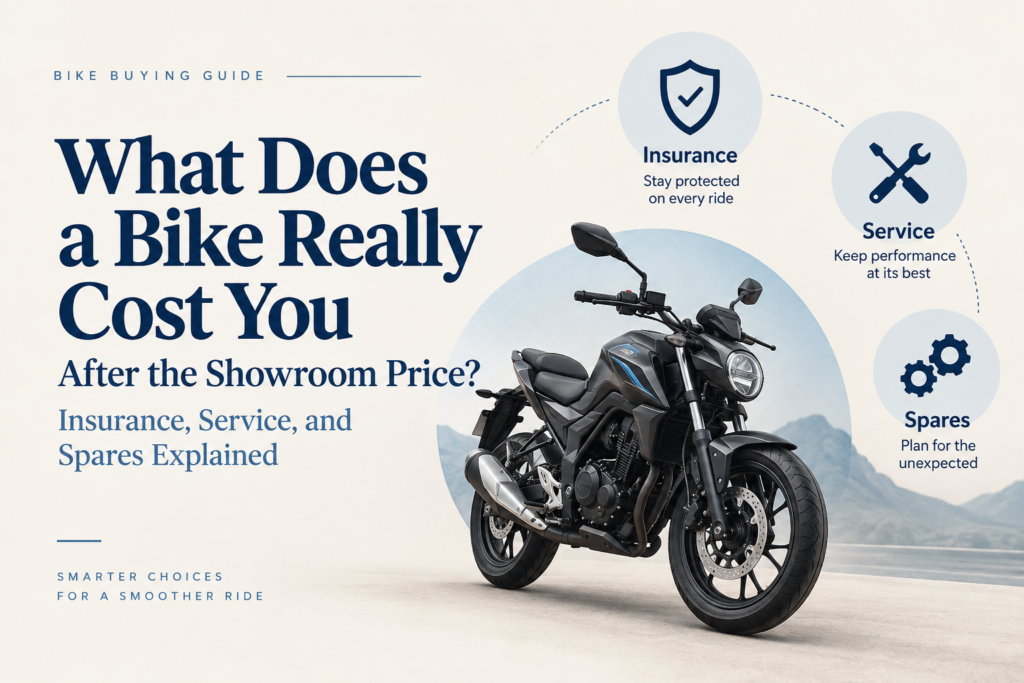
What Does a Bike Really Cost You After the Showroom Price? Insurance, Service, and Spares Explained
 Blogs
Blogs
Buying a bike is exciting, from the glossy brochure to the test ride and finally the showroom delivery. But the on-road price is just the beginning. The real cost of owning a bike includes bike maintenance, insurance, servicing, fuel, and spare parts, all adding up long after you have ridden it off the lot.
Here is what you will actually spend after the showroom price, broken down category by category, so there are no surprises down the road.
1. Insurance Costs
Third-party insurance is mandatory in India, while comprehensive plans additionally cover theft, damage, and rider protection. Annual premiums typically range from 2,000 to 8,000 rupees depending on the bike type and coverage level, with sports bikes and premium models generally attracting higher premiums.
2. Bike Maintenance and Service
Most bikes come with free services in the first year, though consumables like oil and filters remain chargeable even then. Regular servicing costs 1,000 to 3,000 rupees per visit for commuter bikes, and 5,000 rupees or more for premium models, adding up to roughly 4,000 to 10,000 rupees a year depending on usage. Timely servicing is genuinely worth prioritising, since it tends to prevent much bigger repair bills later.
3. Spare Parts and Repairs
Common replacements include brake pads, clutch plates, chain sprockets, and tyres. Brake pads typically cost 500 to 1,500 rupees, tyres run 2,000 to 6,000 rupees each, and a chain kit costs 1,500 to 4,000 rupees. Spares for premium bikes tend to cost two to three times more than equivalent parts for commuter bikes.
The showroom price is the entry ticket, not the real cost. Insurance, servicing, spares, and fuel are what actually decide how much a bike costs you every single year.
4. Fuel Costs and Running Cost Per Kilometre
Claimed mileage and real-world mileage often differ, but as a general guide, commuter bikes deliver around 40 to 50 kilometres per litre, with monthly fuel spend of roughly 2,000 to 3,000 rupees. Premium bikes deliver 20 to 30 kilometres per litre, pushing monthly fuel spend to 5,000 rupees or more. Fuel remains the single biggest recurring expense for most riders.
Combining fuel, servicing, and spares, a commuter bike costs roughly 2 to 3 rupees per kilometre to run, while a premium bike runs closer to 5 to 7 rupees per kilometre. The showroom price is only half the story, since running costs matter far more over the long term.
5. Hidden Costs and the 2026 Ownership Reality
Beyond the obvious expenses, budget for accessories like helmets, riding gear, seat covers, and crash guards, along with one-time but significant registration and taxes. Depreciation also eats into value quickly, with most bikes losing 15 to 20 percent of their value in the first year alone.
- Urban riders tend to spend more on insurance and fuel due to traffic and higher premiums.
- Rural riders often see lower insurance costs but higher wear and tear on spares due to road conditions.
- Smart buyers track mileage and service records closely to keep ownership costs predictable.
6. Frequently Asked Questions
Q: How much does it cost to own a commuter bike per year beyond the showroom price?
Expect roughly 15,000 to 25,000 rupees annually for a commuter bike, covering insurance, servicing, fuel, and spare parts combined.
Q: How much more expensive is it to run a premium bike compared to a commuter bike?
Premium bikes can cross 50,000 rupees a year in total running costs, compared to 15,000 to 25,000 rupees for commuter bikes, due to higher fuel consumption and pricier spares.
Q: What is the biggest recurring cost of owning a bike?
Fuel is typically the biggest recurring expense, especially for premium bikes with lower mileage.
Q: How much value does a bike lose in the first year?
Most bikes depreciate by 15 to 20 percent of their value within the first year of ownership.
Q: Why do premium bikes cost more to maintain than commuter bikes?
Spare parts for premium bikes typically cost two to three times more than equivalent parts for commuter bikes, and servicing rates are also higher.
7. Conclusion
The showroom price is just the entry ticket. Bike maintenance, insurance, servicing, spares, and fuel add up to thousands every year, with commuter bikes typically costing 15,000 to 25,000 rupees annually and premium bikes crossing 50,000 rupees. The smartest way to own a bike is to budget beyond the showroom, since true ownership costs are written on the road, not the price tag.
The showroom price is just one part of the ownership cost. Before you make your decision, get a closer look at the bike’s features and specifications with a product expert through a live demo.