Real-World Mileage vs Claimed Mileage: Why Your Bike Never Matches the Brochure Number
 Blogs
Blogs
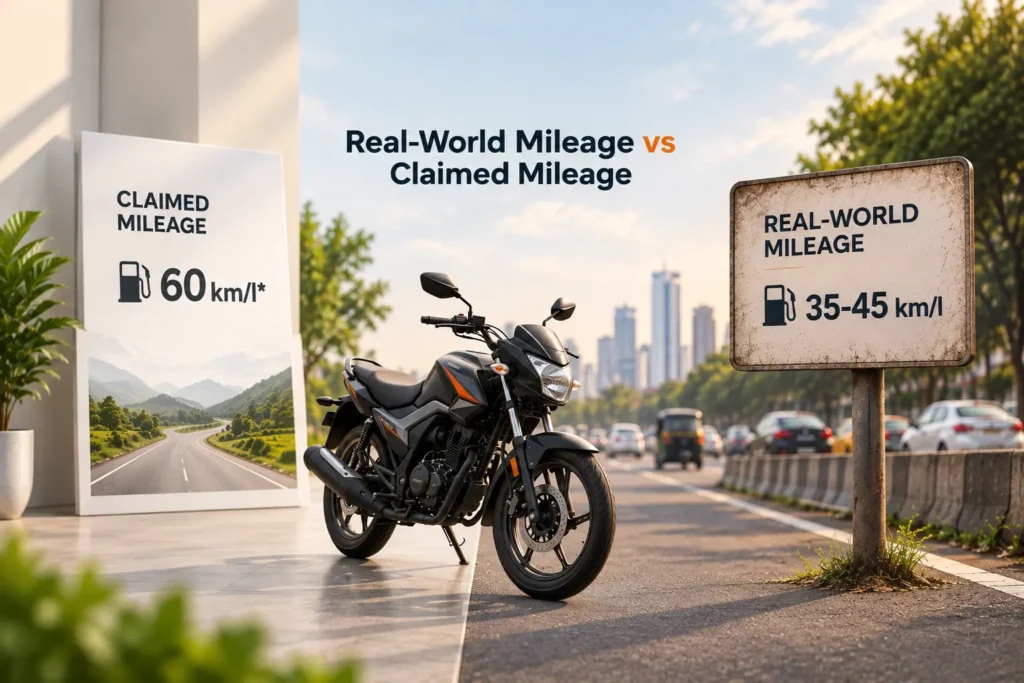
Every rider has faced the same frustration: bike mileage in the showroom brochure rarely matches what actually shows up on the fuel gauge. A manufacturer might claim 60 kilometres per litre, but your daily commute shows closer to 45.
Here is why this gap exists, what it actually means for your wallet, and how to estimate your bike’s true mileage instead of relying on the brochure number.
1. Claimed Mileage: The Lab Number
Manufacturers calculate claimed mileage using standardized testing under controlled lab conditions, often on a dynamometer. These tests use controlled conditions that are very different from everyday riding, without the traffic, frequent stops, varying road conditions and riding behaviour you encounter on Indian roads. The resulting figure is useful for standardized comparison, but it may not match the mileage you achieve on everyday Indian roads.

2. Real-World Bike Mileage and the Everyday Truth
Frequent stops, idling at signals, and bumper-to-bumper traffic all reduce efficiency, while potholes, flyovers, and uneven roads can lead to more frequent speed changes and acceleration. Aggressive acceleration, late braking, or riding with heavy loads can reduce mileage further.
Claimed mileage is measured in a lab with perfect conditions that no commute ever has. Real-world mileage is measured in traffic, on potholes, in the rain, which is exactly why the two numbers rarely agree.
3. Fuel Efficiency Factors You Actually Control
- Tyre pressure: under-inflated tyres increase rolling resistance and hurt mileage.
- Regular servicing: clean air filters, proper engine oil, and tuned carburettors or injectors all improve mileage.
- Riding style: smooth acceleration and steady speeds genuinely save fuel.
- Load management: avoiding unnecessary weight or oversized accessories helps preserve mileage.
4. Why the Gap Actually Matters
If your bike claims 60 kilometres per litre but delivers 45, you use about 33 percent more fuel to cover the same distance than you would at 60 kilometres per litre. Riders often feel misled by this gap, but understanding where it comes from helps set realistic expectations. Real-world mileage is also the only fair way to compare bikes against each other, since claimed figures tend to be uniformly inflated across the industry.
5. How to Estimate Your Bike’s True Mileage
The simplest approach is the tank-full method: fill your tank completely, reset the trip meter, ride until the next refill, then divide kilometres travelled by litres used. For more accuracy, track this average across multiple refills to smooth out variations, and take advantage of digital aids, since many modern bikes and apps now track fuel efficiency automatically.

6. Frequently Asked Questions
Q: Why does my bike’s real mileage never match the claimed figure?
Claimed mileage is measured in controlled lab conditions with perfect riding behaviour, while real-world mileage accounts for traffic, road quality, weather, and actual riding habits.
Q: How much fuel cost difference does the mileage gap actually create?
If a bike claims 60 km/l but delivers 45 km/l, you use about 33 percent more fuel to cover the same distance than you would at 60 km/l.
Q: What is the best way to check my bike’s real mileage?
The tank-full method works well: fill the tank, reset the trip meter, ride until the next refill, then divide kilometres by litres used, ideally averaged across multiple refills.
Q: Does tyre pressure really affect bike mileage?
Yes. Under-inflated tyres increase rolling resistance, which directly reduces fuel efficiency.
Q: Can riding style actually improve real-world mileage?
Yes. Smooth acceleration, steady speeds, and avoiding unnecessary load can meaningfully narrow the gap between claimed and real-world mileage.
7. Conclusion
Claimed mileage is a marketing number, while real-world mileage is the truth your wallet actually feels. By maintaining your bike properly and adopting fuel-efficient riding habits, you can narrow that gap. The next time a glossy brochure promises sky-high mileage, remember that the real story gets written on the road, not in the lab.