What TDS Level Actually Makes Tap Water Safe to Drink?
 Blogs
Blogs
Water is life. We drink it every day to stay healthy, active, and hydrated. But have you ever looked closely at your tap water and wondered what is actually hiding inside it, and what the safe TDS level for drinking water really is?
If you have ever looked up water filters, you have likely come across the term “TDS.” Many companies claim their purifiers give you the perfect safe TDS level for drinking water. But what do these letters mean? How do you check it? And what is the ideal number for your family’s health?
This guide will explain everything simply, break down the numbers, and teach you how to read a TDS meter reading like a pro.
1. What is TDS?
TDS stands for Total Dissolved Solids. Think of your water as a tiny liquid highway. As water travels through the ground, rocks, and old city pipes to reach your tap, it picks up passenger particles along the way. These particles dissolve completely in the water, making them invisible to the naked eye.
TDS includes a mix of:
- Good Minerals: Calcium, magnesium, and potassium that our bodies need.
- Natural Salts: Carbonates and chlorides.
- Harmful Pollutants: Lead, arsenic, nitrates, and agricultural chemicals that run off into water sources.
A TDS test measures the total weight of all these invisible passengers. It is measured in ppm, which stands for parts per million. If your water has a TDS of 100 ppm, it means that for every one million parts of water, there are 100 parts of dissolved solids.
2. The Master TDS Chart: Good vs. Bad Numbers
Not all TDS is bad. In fact, water with zero TDS tastes completely flat and boring because it lacks healthy minerals!
According to global health experts and the World Health Organization (WHO), here is how to understand your TDS meter reading:
| TDS Level (ppm) | Quality Classification | What It Means for You |
| Less than 50 | Unacceptable / Poor | Too low! Lacks vital minerals. Tastes flat and can taste bitter. |
| 50 to 150 | Good | Great for drinking. Contains a baseline of healthy minerals. |
| 150 to 300 | Excellent | The absolute sweet spot! Tastes crisp, clean, and highly refreshing. |
| 300 to 500 | Fair / Acceptable | Safe to drink, but might taste slightly heavy or hard. |
| 500 to 1,200 | Poor | Tastes bad, metallic, or salty. Hard water that scales up pipes. |
| Above 1,200 | Toxic / Unsafe | Completely unacceptable. Dangerous for health and household appliances. |
As you can see, the safe TDS level for drinking water falls anywhere between 50 ppm and 500 ppm. However, for the best taste and health benefits, you should aim for the golden zone of 150 ppm to 300 ppm.
3. The Hidden Trap: Why TDS Doesn’t Tell the Whole Story
Here is a major secret that water purifier salespeople won’t tell you: A low TDS reading does not automatically mean your water is safe.
A TDS meter is blind to biological dangers. It cannot detect:
- Bacteria (like E. coli)
- Viruses
- Parasites
- Microplastics
- Pesticides
Imagine two glasses of water. Glass A has a TDS of 400 ppm because it contains natural rock minerals like calcium. Glass B has a low TDS of 40 ppm but contains deadly bacteria from sewage. Your TDS meter will say Glass B is “better,” even though drinking it will make you incredibly sick!
Therefore, a safe TDS level for drinking water must always be paired with proper purification to remove invisible biological germs.
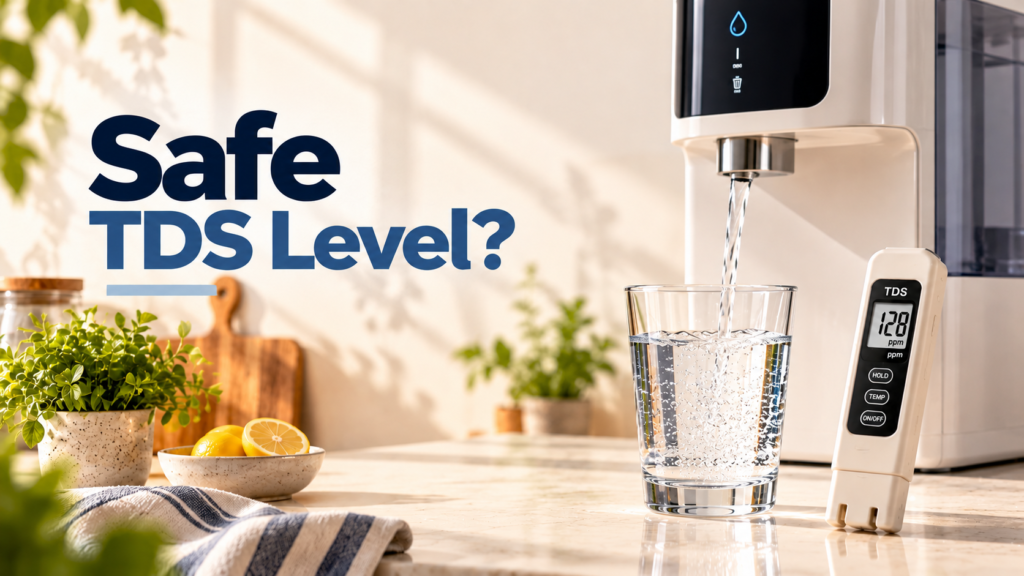
4. How to Check Your Water Using a TDS Meter
Testing your water at home is incredibly easy and inexpensive. You can buy a digital pocket TDS meter online for the price of a couple of coffees.
Here is how to get an accurate TDS meter reading in four simple steps:
- Fill a Clean Glass: Draw a fresh sample of tap water into a clean, dry glass cup.
- Turn on the Meter: Press the power button on your digital TDS meter. The screen should read 000.
- Dip the Sensor: Submerge the metal prongs at the bottom of the meter into the water. Do not submerge the entire plastic device!
- Read and Hold: Stir the water gently for 5 seconds. Wait for the numbers on the digital screen to stop shifting, then press the “Hold” button to lock in your score.
5. How to Choose the Right Water Filter Based on Your TDS
Once you know your tap water’s score, you can pick the perfect water filter without wasting money on features you do not need:
- If your TDS is above 500 ppm: Your water is very hard and salty. You absolutely need an RO (Reverse Osmosis) purifier. RO filters use a fine membrane to slash high TDS levels down by 90%, making heavy water light and sweet.
- If your TDS is between 150 and 400 ppm: Your TDS is already in a great place! Avoid standard RO filters because they will strip away your good minerals and drop your TDS too low. Instead, use a UV + UF (Ultraviolet + Ultrafiltration) purifier. This kills 100% of germs and bacteria while keeping your healthy minerals intact.
- If your TDS is below 100 ppm: Your water is soft but lacks minerals. Look for a purifier equipped with a Mineral Modulator or TDS Controller to actively add healthy calcium and magnesium back into your drinking glass.
6. Frequently Asked Questions
Q: What is the safe TDS level for drinking water?
In India, the BIS standard IS 10500:2012 treats TDS up to 500 ppm as acceptable for drinking water, and allows up to 2,000 ppm only where no better source is available. For taste, most people prefer water in the 150 to 300 ppm range shown in the chart above. TDS on its own does not confirm that water is safe, so germs and chemical contaminants still need to be dealt with separately.
Q: Is low TDS water safe to drink?
A low TDS reading does not tell you whether water is safe. It only means there are fewer dissolved minerals and salts in it. Water below about 50 ppm tends to taste flat because it lacks minerals, and a TDS meter cannot detect bacteria, viruses or pesticides, so low TDS water still needs proper purification.
Q: Can a TDS meter tell me if my water is safe?
No. A TDS meter only measures the total dissolved solids in your water. It cannot detect bacteria, viruses, parasites, microplastics or pesticides. Use it to choose the right type of purifier, and get a lab test if you are worried about specific contaminants.
Q: Do I need an RO purifier if my TDS is under 300 ppm?
Usually not. If your TDS is roughly between 150 and 400 ppm, a UV + UF purifier is a better fit, because it treats germs while keeping the healthy minerals. RO is mainly needed when TDS is above 500 ppm, or when a lab test shows dissolved contaminants such as heavy metals.
Q: What should I do if my TDS is below 100 ppm?
Water this soft is low in minerals. Look for a purifier with a Mineral Modulator or TDS Controller, which adds calcium and magnesium back into your drinking water.
7. The Bottom Line
A safe TDS level for drinking water means finding a healthy balance. You do not want water that is stuffed with heavy metals, but you also do not want dead, empty water that robs your body of nourishment.
Buy a simple tool, take a quick TDS meter reading of your tap water, and choose a purification system that treats your specific water type. Your health, your wallet, and your tastebuds will thank you!