RO vs UV vs UF: What Do These Water Purifier Letters Actually Mean?
 Blogs
Blogs
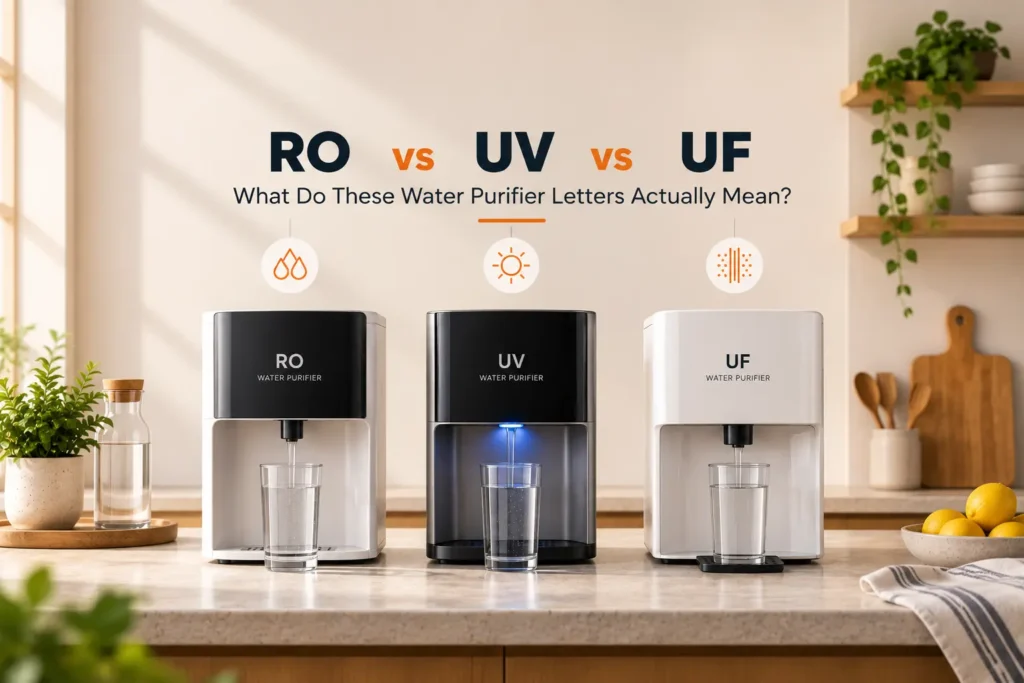
Walk into any appliance store and you will see different types of water purifier, including RO, UV and UF. For most buyers, these acronyms are genuinely confusing.Do you really need RO? Is UV enough on its own? What does UF even do?
Here is a clear breakdown of these three purification technologies, and which one actually suits your home’s water supply.
1. RO: Reverse Osmosis
RO works by forcing water through a semi-permeable membrane that can reduce dissolved salts and certain contaminants. It is generally considered when water has high TDS or specific dissolved contaminants, but testing your water first helps determine whether RO is appropriate
Its limitations include wasting some water during the purification process, needing electricity to run the pump, and stripping out natural minerals, which is why many RO systems add mineral cartridges back afterward.
2. UV: Ultraviolet Purification
UV purification exposes water to ultraviolet light that kills bacteria and viruses. It offers chemical-free disinfection, retains the water’s natural taste and minerals, and stays compact with low maintenance needs. Its main limitations are that it cannot remove dissolved salts or heavy metals, and it requires reasonably clear water, since cloudiness reduces its effectiveness.
RO, UV, and UF are not interchangeable marketing letters. Each one solves a different water problem, and picking the wrong one means paying for protection your water supply never actually needed.
3. UF: Ultrafiltration
UF uses a fine membrane to filter out bacteria, cysts, and larger particles, all without needing electricity. It works well for municipal water supplies with low TDS, and it tends to be durable and easy to maintain. Its limitations are that it cannot remove dissolved salts or chemicals, and it is not well suited to groundwater with high contamination levels.
4. Types of Water Purifier: Which One Should You Choose?
- High TDS or specific dissolved contaminants: RO may be appropriate, particularly where testing shows that dissolved contaminants need to be reduced.
- Municipal water with low TDS: UV or UF may be appropriate depending on whether microbial or suspended-particle contamination is the main concern.
- Mixed water supply: RO, UV and UF combo purifiers have become popular in many Indian homes.
5. The 2026 Purifier Reality
In urban homes, combo purifiers dominate, offering RO for dissolved salts and UV for microbial safety together. In rural areas, UF purifiers remain practical wherever electricity is unreliable. From a health standpoint, RO ensures safety in industrial or polluted regions, while UV and UF remain eco-friendly options for cleaner water sources.
6. Frequently Asked Questions
Q: What is the difference between RO, UV, and UF water purifiers?
RO removes dissolved salts and heavy metals using a membrane, UV disinfects water using ultraviolet light, and UF filters out bacteria and cysts using only water pressure without electricity.
Q: Do I need an RO purifier if I have municipal water supply?
Not necessarily. If your municipal supply has low TDS, a UV or UF purifier may be sufficient without the added cost and water wastage of RO.
Q: Which water purifier works without electricity?
UF, or ultrafiltration, purifiers work without electricity, relying purely on water pressure to filter out bacteria and larger particles.
Q: Why do RO purifiers need mineral cartridges added back?
Because the RO membrane strips out natural minerals along with contaminants, many systems add a mineral cartridge afterward to restore taste and nutritional value.
Q: Is a combo RO, UV and UF purifier worth it?
For homes with mixed or uncertain water quality, yes, since it covers dissolved salts, microbial contamination, and larger particles all in one system.
7. Conclusion
Understanding the types of water purifier available makes it easier to choose a system based on your water quality, contaminants and household needs.If your water has high TDS, go for RO. If you rely on treated municipal supply, UV or UF may be enough. For maximum safety across the board, a combination system balances purity, taste, and convenience.