What RO Purifier Storage Capacity Does Your Family Actually Need?
 Blogs
Blogs
Buying a new RO water purifier for home is one of the most important decisions you will make for your home’s health. You will likely spend hours comparing filtration technologies like RO, UV, UF and copper filters, yet buyers frequently overlook one crucial technical specification until the machine is mounted on the wall: the storage tank capacity.
Choosing the wrong storage tank size leads to daily frustration. Too small, and you will constantly wait for the machine to refill during morning rush hours. Too large, and water can sit stagnant for days, increasing the risk of secondary bacterial contamination. Here is exactly what litre capacity your household needs, based on family size, water habits, and local power conditions.
1. Why Storage Capacity Matters in an RO Purifier
Unlike traditional gravity filters or online UV purifiers that dispense water instantly, a reverse osmosis system works slowly. The RO membrane purifies water drop by drop, forcing it through microscopic pores to eliminate heavy metals and dissolved solids. Because purification takes time, an internal storage tank is necessary, collecting and holding purified water so you can fill bottles, cooking pots and glasses instantly without waiting. The right tank size for an RO purifier ensures a steady, uninterrupted supply of clean water whenever you turn the tap.
2. The Crucial Factor: Power Outages and Water Disruptions
When choosing an RO purifier tank capacity for your family’s needs, your local infrastructure matters just as much as the number of people in your house. RO purifiers require electricity to run their internal booster pumps, so if your area experiences frequent, multi-hour power cuts or unpredictable water supply, your purifier cannot generate new clean water during those down periods. In these environments, treat your purifier’s tank as an emergency reservoir and lean toward a larger litre capacity to ensure your family has enough drinking water to outlast a typical outage.
The right RO storage capacity is not about buying the biggest tank available. It is about matching litres to your family size, your power supply, and how stagnant you are willing to let water sit.
3. Storage Capacity Breakdown by Family Size
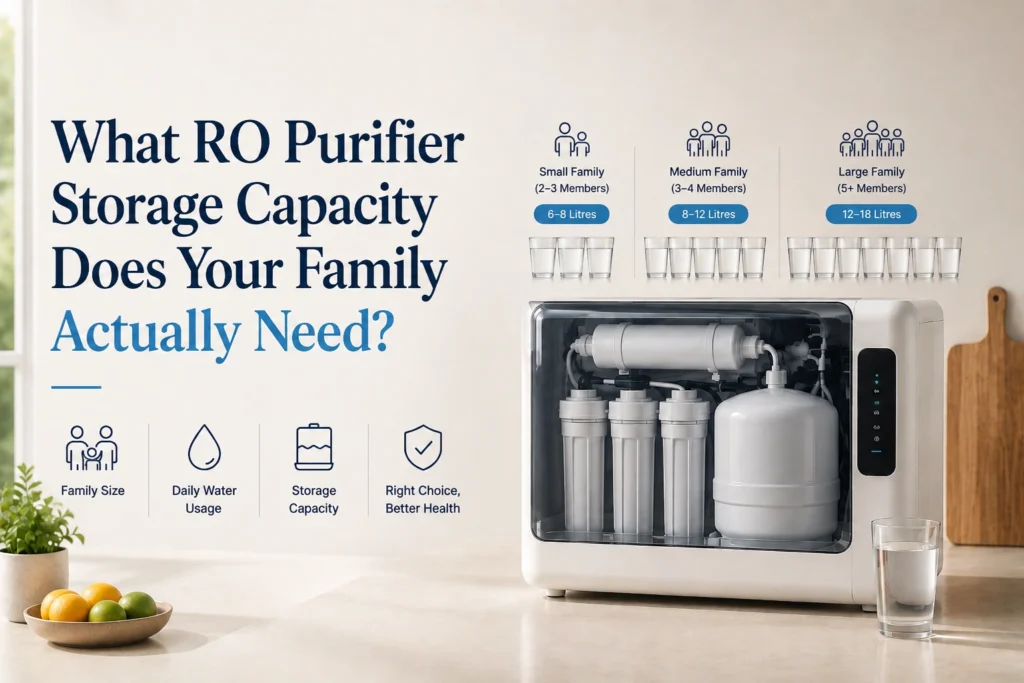
Choosing an RO water purifier for home starts with understanding how much storage capacity your family actually needs. The ideal tank size depends on the number of people in your household, daily water consumption, and how frequently you use purified water.
1. Small Families or Bachelors (1 to 3 Members)
Recommended capacity: 5 to 7 litres. A small household uses water in small, spaced-out increments, and a 6-litre tank provides more than enough for drinking and basic cooking needs without taking up excessive space in compact kitchens.
2. Medium Families (4 to 5 Members)
The golden question here is how many litres an RO purifier needs for 4 members, and the recommended capacity is 7 to 9 litres. For a standard family of four, an 8-litre tank is the sweet spot, easily covering heavy morning demands like filling school bottles, office flasks and large pots for cooking breakfast, and the unit will automatically refill itself throughout the day as water is drawn.
3. Large or Joint Families (6+ Members)
Recommended capacity: 10 to 14 litres, or a direct-flow commercial unit. Choosing the right RO purifier capacity for a large family requires calculating peak usage times, since smaller tanks empty completely in minutes when multiple people need water simultaneously.. A robust 12-litre tank ensures high-volume availability.
4. Tank Material: Food-Grade Plastic vs Stainless Steel
Once you determine your ideal volume, consider the material of the reservoir.
- Food-grade ABS plastic: the most common option, lightweight, durable and cost-effective. Make sure the manufacturer specifies the plastic is BPA-free to prevent chemicals leaching into stored water.
- Stainless steel tanks: found in premium models, offering superior hygiene, preventing algae and bacteria growth over long storage periods, and generally more durable than plastic.
5. Summary Checklist for Buyers
- Frequent power cuts: select a tank size one tier larger than your family size typically requires.
- Tight kitchen space: consider a compact 6-litre under-counter model to keep countertops clear.
- Heavy cooking needs: if you use purified water for washing vegetables and boiling large quantities of rice or lentils, add an extra 2 litres to your baseline calculation.
6. Frequently Asked Questions
Q: How many litres of RO purifier storage does a family of 4 need?
Generally 7 to 9 litres, with an 8-litre tank being the practical sweet spot for most 4-member households.
Q: What storage capacity does an RO water purifier for home need for a large family?
10 to 14 litres, or a direct-flow commercial unit, to avoid the tank running empty during simultaneous peak usage.
Q: Does frequent power cuts change how much storage I need?
Yes. If your area has frequent multi-hour power cuts, choose a tank size one tier larger so your family has enough water to outlast a typical outage.
Q: Is a larger storage tank always better?
No. An oversized tank for your household can let water sit stagnant for days, increasing the risk of secondary bacterial contamination.
Q: Is stainless steel better than plastic for an RO storage tank?
Stainless steel offers better hygiene and durability over time, while food-grade, BPA-free plastic is lighter and more budget-friendly for most households.
7. Conclusion
Investing a few minutes to calculate your actual daily water consumption ensures you buy a purifier that fits seamlessly into your household routine, without wasting energy, space, or money.