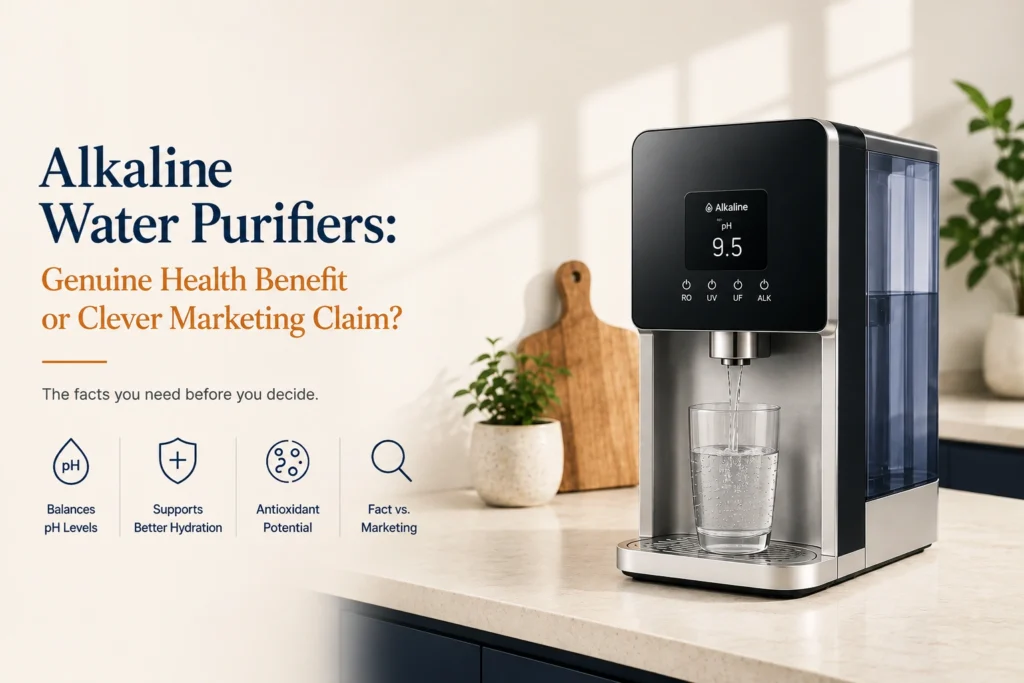
Alkaline Water Purifiers: Genuine Health Benefit or Clever Marketing Claim?
 Blogs
Blogs
Walk into any modern home appliance store, and you will see shelves lined with premium filtration systems, including the alkaline water purifier, boasting a highly attractive health claim: the ability to produce alkaline water. These machines promise to do far more than just clean your tap water, claiming to balance your body’s pH, boost your energy, and even slow down ageing.
With search interest in alkaline water purifiers climbing steadily, it is clear that health-conscious buyers are paying attention. But does shifting the pH of your drinking water truly unlock these benefits, or are you paying for a sophisticated marketing campaign? Here are the real alkaline water purifier benefits and risks.
1. What Exactly Is Alkaline Water
The term pH stands for potential of hydrogen, which measures how acidic or basic a water-based solution is on a scale from 0 to 14.
- pH 7.0 is perfectly neutral water.
- Below pH 7.0 is acidic water, like lemon juice or coffee.
- Above pH 7.0 is alkaline, or basic, water.
Normal drinking water usually sits at a neutral 7.0. An alkaline water purifier uses electrolysis, or passes water through an alkaline cartridge packed with active minerals, to raise the pH to 8.0, 9.0, or even 9.5, while also infusing the water with beneficial minerals like calcium, magnesium and potassium.
2. Does Alkaline Water Really Improve Health
The human body is an incredibly sophisticated machine. Your lungs, kidneys and blood maintain a strict systemic pH of about 7.4 regardless of what you eat or drink, and your body will automatically self-regulate to keep this internal chemistry stable. Drinking high-pH water cannot alter your bloodstream’s fundamental pH balance.
However, focusing only on body pH ignores some proven, localised alkaline water purifier benefits:
- Acid reflux relief: clinical studies show that water with a pH of 8.8 can deactivate pepsin, the primary enzyme responsible for acid reflux, offering real relief to chronic heartburn sufferers.
- Enhanced mineral intake: alkaline cartridges reintroduce vital minerals like calcium and magnesium that are otherwise stripped away by aggressive purification systems.
- Better cellular hydration: some small-scale research suggests basic water has a smaller molecular cluster size, allowing cells to absorb fluid slightly faster after intense physical exercise.
Alkaline water cannot change your blood’s pH, your body already controls that tightly. What it can genuinely do is put back the minerals that plain RO filtration strips away.
3. Alkaline vs RO Water Purifier: Which Is Better
When shopping, the key matchup is alkaline vs RO water purifier, which is better for everyday home use? Standard Reverse Osmosis purifiers use a hyper-fine, semi-permeable membrane to remove heavy metals, dissolved solids, arsenic and lead, which is essential if your water source is highly contaminated. However, RO filtration is non-discriminatory, stripping out good minerals alongside the bad and leaving the final output slightly acidic, around 6.0 to 6.5 pH.
An alkaline purifier addresses this specific gap by adding an active mineraliser module after the RO membrane stage, or using ionisation to bring the water back to a balanced state.
- Choose standalone RO if your water source has dangerously high TDS, above 500 ppm, and you are solely focused on removing heavy contaminants.
- Choose RO plus alkaline if you want pure water that is also mineral-rich, better-tasting, and balanced in pH.
4. Alkaline Water Purifier Benefits and Risks
The Benefits
- Improved taste: reintroducing pure calcium and magnesium makes the water taste crisp and sweet.
- Antioxidant properties: high-end water ionisers generate a negative Oxidation-Reduction Potential, which helps neutralise free radicals in the body.
- Bone health support: consistently absorbing mineral-rich water helps prevent the body from leaching calcium out of the bones to maintain blood pH.
The Risks
- Stomach acid neutralisation: the stomach needs a highly acidic environment, pH 1.5 to 3.5, to break down food and kill harmful bacteria. Drinking large volumes of high-pH water right before or during a heavy meal can dilute these digestive juices, leading to bloating or indigestion.
- Skin and eye dryness: using highly alkaline water to wash your face can disrupt the skin’s natural acidic protective barrier, causing irritation.
5. The Final Equation: Price vs Benefit
When weighing alkaline water purifier price against benefit, budget matters. A standard RO system can cost anywhere from ₹8,000 to ₹15,000. Adding an integrated alkaline module can push that up to ₹20,000 or ₹30,000, while dedicated Japanese electrolytic ionisers can easily climb well past ₹1,00,000.
So, is an alkaline water purifier good for health? Yes, it is a worthwhile upgrade, primarily because it restores essential minerals that pure RO systems aggressively strip out. You do not need to spend an exorbitant amount on a luxury ioniser. A reliable, mid-range RO system equipped with an alkaline copper or mineral cartridge provides a solid balance of purity, nutrition and everyday safety.
6. Frequently Asked Questions
Q: Is alkaline water actually good for your health?
It offers real benefits like restoring stripped minerals and some relief from acid reflux, but it cannot change your body’s internal pH, which is tightly self-regulated regardless of what you drink.
Q: Is an alkaline water purifier better than a standard RO purifier?
Not better, but complementary. RO removes contaminants effectively but strips out minerals too, and an alkaline module or cartridge adds those minerals back and balances the pH.
Q: Are there any risks to drinking alkaline water?
Drinking large volumes with meals can dilute stomach acid needed for digestion, and washing your face with highly alkaline water can dry out your skin.
Q: How much more does an alkaline water purifier cost?
An integrated alkaline module typically adds ₹5,000 to ₹15,000 over a standard RO system, while dedicated electrolytic ionisers can cost well over ₹1,00,000.
Q: Do I need alkaline water if my RO purifier already works well?
If your priority is restoring minerals and improving taste rather than just removing contaminants, adding an alkaline module is a worthwhile, moderate-cost upgrade.
7. Conclusion
Alkaline water purifiers are not a medical miracle, but they are not just marketing either. The real value lies in restoring minerals that reverse osmosis strips away, not in changing your body’s pH.