Why Your Home Water Purifier Needs More Attention Than You Think
 Blogs
Blogs
Water is the invisible foundation of our daily lives. We drink it, cook with it, and use it for everything from morning chai to medication. And at the centre of all that sits a single appliance we rarely think about once it is installed. Regular water purifier maintenance is essential to keep it working effectively and safely.
This is where a dangerous misconception takes root. A water purifier is not a set-and-forget appliance. It is a living filtration system with internal components that degrade, clog, and eventually fail silently. When they do, your purifier continues to dispense water that looks clean but may no longer be safe to drink.
1. The Trap of the Visually Clean Illusion
The biggest threat to home water safety is our reliance on visual cues. We judge water quality by its appearance, and purified water almost always looks perfectly clear and clean. This is a dangerous illusion.
The most hazardous water contaminants are completely invisible, tasteless, and odourless. Dissolved heavy metals like lead, arsenic, and chromium leave no trace in taste or colour but accumulate in the body over years. Volatile Organic Compounds (VOCs), pesticides, and industrial runoff do not necessarily change the appearance of water at all. And when a water purifier’s internal filters become saturated, they lose their ability to trap these invisible threats, while the water coming out continues to look pristine.
The result is a false sense of security: you trust the appliance, but the appliance has quietly stopped protecting you.
2. The Biofilm Threat: When Filters Become Breeding Grounds
Most purification systems use a combination of physical filtration membranes and activated carbon to capture contaminants. When these filters trap organic matter, sediment, and chlorine-reduced water over several months, they create dark, damp, nutrient-rich conditions that are ideal for microbial growth.
Over time, microorganisms can form a slimy layer known as a biofilm inside the filter cartridges, internal tubing, and storage tanks. Once biofilm is established, it becomes a constant source of recontamination, releasing bacteria into every glass of water you pour. This is the ironic worst-case scenario: a purifier that is actively making your water less safe than the tap.
3. The Anatomy of Filtration Decline
A multi-stage water purifier relies on a precise sequence of filters, each with a specific lifespan and function. When one fails, the downstream components are directly impacted:
Stage 1: The Sediment Filter
This is the first line of defence, trapping mud, sand, rust, and large particles. If left unchanged, it clogs completely, restricts water flow, and forces the internal pump to work harder than it was designed to. A strained pump overheats and fails, which is one of the most expensive repairs a water purifier can require.
Stage 2: The Activated Carbon Filter
Carbon filters use adsorption to remove chlorine, organic chemicals, and bad tastes. Carbon has a finite number of bonding sites. Once every site is occupied, the filter passes contaminants through rather than trapping them, and starts exposing the expensive RO membrane to chlorine that it is not designed to handle. Chlorine degrades RO membranes rapidly.
Stage 3: The RO Membrane or UV Chamber
The Reverse Osmosis membrane is the sophisticated, expensive heart of the system. If the upstream filters have failed, the membrane is exposed to chlorine, sediment, and organic load far beyond its design tolerance. It clogs, develops micro-tears, and loses its ability to remove dissolved solids. Once damaged, no amount of cleaning can restore it. The only solution is full replacement, which costs significantly more than a routine service.
4. The Hidden Financial Cost of Neglect
Many homeowners delay water purifier maintenance to save money on replacement parts. This logic consistently backfires. Ignoring basic maintenance schedules triggers a cascade of expensive mechanical failures:
- Membrane destruction: Replacing a sediment or carbon filter costs a fraction of replacing a damaged RO membrane.
- Pump burnout: Clogged filters restrict water flow, causing the internal booster pump to overheat. Pump replacement is far more expensive than filter replacement.
- Water waste inflation: As RO membranes age and degrade, their efficiency ratios collapse. A neglected RO system will reject far more water per litre produced, significantly increasing your water bills over time.
- Full system replacement: When multiple components fail simultaneously, the repair cost often exceeds the price of a new unit. Regular servicing would have prevented this entirely.
The math is simple: a timely filter change costing a few hundred rupees prevents a repair or replacement that can cost several thousand.
5. Water Purifier Maintenance: A Practical Guide
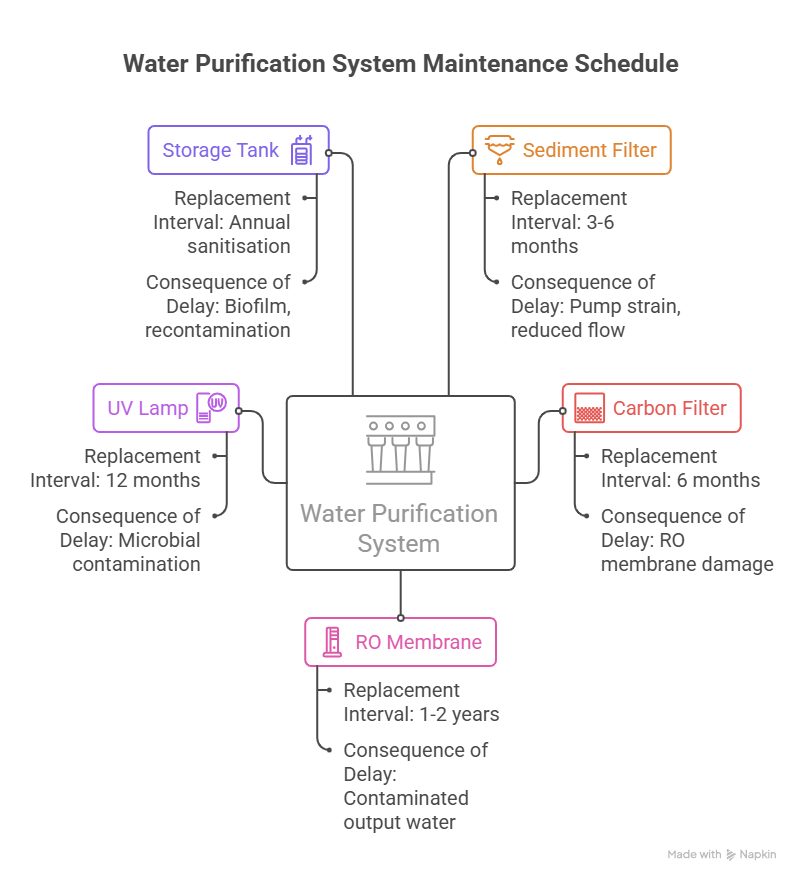
Taking control of your home water safety does not require an engineering degree. It requires only consistency and a basic understanding of your machine.
Note: These intervals can vary based on your local source water quality and daily household consumption. High-TDS water or heavy daily use may require more frequent changes.
Frequently Asked Questions
Q: How do I know if my water purifier filters need changing?
Common signs include a noticeable drop in water flow rate, a change in taste or smell, the purifier running longer than usual to fill its tank, or the service indicator light if your model has one. When in doubt, have the filters checked at or before the manufacturer’s recommended service interval.
Q: Can I clean and reuse RO membranes instead of replacing them?
No. RO membranes cannot be effectively cleaned once they are degraded or contaminated. Attempting to rinse or manually clean them typically causes further damage. Replacement is the only reliable option once the membrane has exceeded its lifespan.
Q: My water still tastes fine. Does that mean the purifier is working correctly?
Not necessarily. As explained in the blog, the most dangerous contaminants (heavy metals, VOCs, and certain bacteria) are tasteless, colourless, and odourless. A purifier that looks and smells fine may have already lost its ability to remove these threats.
Q: How often should I get my water purifier serviced professionally?
Most manufacturers recommend a professional service visit every 6 to 12 months, depending on usage and source water quality. Some brands include a service contract as part of the purchase. If yours does not, scheduling an annual visit is a good baseline.
Q: Is it better to service the purifier myself or call a technician?
Pre-filter and carbon filter replacements can typically be done at home following the user manual. However, RO membrane replacement, pump checks, and UV chamber servicing should be handled by a trained technician to avoid damage and ensure the system is correctly reassembled.
Conclusion
A home water purifier is an outstanding investment in your family’s long-term health, but it is only as good as the care it receives. The invisible threats it was installed to stop will continue flowing through a neglected system without warning.
Do not wait for your water to taste strange, smell odd, or slow to a trickle before you take action. Treat your purifier like any other critical appliance in your home: make water purifier maintenance part of your regular routine, replace filters on time, and get professional service once a year.
Want to see how a modern water purifier works before buying one? Book a free live video session with one of our product experts and get a real-time walkthrough of any model you are considering.