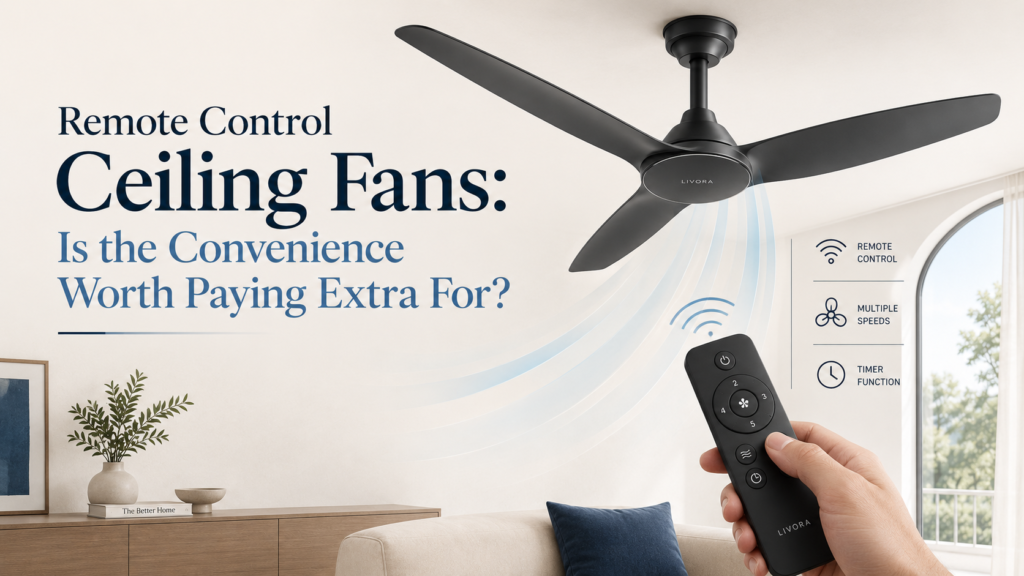
Remote Control Ceiling Fans: Is the Convenience Worth Paying Extra For?
 Blogs
Blogs
The humble ceiling fan has remained a permanent fixture in Indian households for decades. For generations, controlling a fan meant walking over to a wall switchboard and twisting a bulky, mechanical step-regulator. If the room grew too cold at 3 AM, you had to disrupt your sleep, climb out of bed, and manually adjust the speed.
Modern smart home technology has completely transformed this everyday appliance. Walk into any home appliance store today and a significant portion of new models come equipped with a dedicated remote control ceiling fan. This upgrade naturally introduces a price premium, which brings up an important question for buyers that, is a remote control ceiling fan worth the extra cost, or is it an unnecessary luxury? Here is how a remote control ceiling fan compares to a regular fan setup, the long-term energy savings involved, and whether this upgrade fits your lifestyle.
1. Understanding the Upgrade: Remote Control vs Regular Fans
The Regular Fan Setup
Traditional models use basic Alternating Current (AC) induction motors wired directly into your home’s wall switchboard. They rely on simple analog voltage drops managed by a wall dial to change speeds.
The Remote Fan Setup
Modern remote-operated units typically use a BLDC remote fan configuration. Brushless Direct Current motors feature integrated electronic motherboards and microprocessors directly inside the fan assembly. The remote control communicates wirelessly with this internal computer chip using Infrared or Radio Frequency signals, letting you bypass manual wall switches entirely.

2. The Real Perks: BLDC Fan with Remote Control Benefits
Upgrading to a BLDC fan with remote control benefits your household in several practical ways that extend far beyond simple convenience.
1. Instant Speed Tuning and Timer Controls
Standard wall regulators only offer 4 or 5 rigid speed clicks. A remote-controlled model typically offers 6 distinct speed settings, letting you fine-tune the breeze to your exact comfort level. Almost all premium remotes also include a Timer Mode, with options like 1, 2, 4 or 8 hours, so you can program the fan to automatically turn off or lower its speed in the early hours of the morning, ensuring an undisturbed sleep cycle.
2. Specialized Smart Modes
Many modern remotes feature a dedicated Sleep Mode or Breeze Mode. When activated, the fan intelligently decreases its speed step by step as the ambient night temperature drops, preventing you from waking up shivering at dawn. Some models also include a Reverse Mode on the remote, which spins the blades backward to distribute warm air evenly during colder winter months.
3. Absolute Accessibility
For elderly family members, indivsiduals with limited mobility, or bedrooms with poorly positioned wall switches, a remote control is a genuinely useful safety upgrade. It eliminates the need to stretch over furniture or walk across a dark room to adjust the airflow.
A remote control ceiling fan is not just a convenience upgrade. Pair it with a BLDC motor and the electricity savings alone can repay the extra cost within a year and a half.
3. Remote Control Ceiling Fan Price in India
When looking at the remote control ceiling fan price in India, you will notice a distinct price bracket variation. A standard, non-remote AC fan costs anywhere from 1,500 to 2,500 rupees. A premium BLDC remote fan typically ranges from 3,000 to 6,000 rupees, depending on the brand, aesthetic design, and integrated LED light features.
While the initial remote fan price is nearly double that of a basic model, the electricity math changes the equation. A standard fan consumes around 75 to 80 watts of power, while a BLDC remote model delivers the same air circulation while consuming a mere 28 to 35 watts. Because it slashes your fan’s electricity usage by up to 60 percent, the appliance effectively pays back its premium price difference within 12 to 18 months of regular daily use.
4. Finding the Best Remote Control Ceiling Fan for Bedroom Spaces
If you are looking to upgrade your sleeping environment, selecting the best remote control ceiling fan for bedroom comfort requires looking for a few specific technical features.
- Radio Frequency vs Infrared: IR remotes require a direct line of sight, meaning you have to point the device directly at the ceiling fan’s center hub. RF remotes work from any angle, letting you adjust the fan speed even from under a heavy blanket.
- Silent button operation: make sure the internal receiver does not emit a loud, piercing beep every time you press a button, since this can easily startle a sleeping infant or partner.
- Wall mount holder: look for models that include a dedicated wall-mountable cradle so you can easily store the remote next to your bed or door frame without losing it.

5. Frequently Asked Questions
Q: Is a remote control ceiling fan worth the extra cost?
For main living areas, dining halls and bedrooms, yes. When paired with a BLDC motor, the lower electricity bills and added comfort modes make the premium worthwhile over time.
Q: What is the price difference between a remote control ceiling fan and a regular fan in India?
A standard AC fan costs roughly 1,500 to 2,500 rupees, while a premium BLDC remote fan ranges from 3,000 to 6,000 rupees depending on brand and features.
Q: Is RF or IR better for a ceiling fan remote control?
RF is generally more convenient since it works from any angle without needing a direct line of sight, while IR remotes must point directly at the fan’s center hub.
Q: Do BLDC remote fans actually save electricity?
Yes. A BLDC remote fan typically consumes 28 to 35 watts compared to 75 to 80 watts for a standard AC fan, cutting electricity usage by up to 60 percent.
Q: What should I look for in the best remote control ceiling fan for a bedroom?
Prioritise an RF remote for flexible use under blankets, silent button operation to avoid startling sleeping family members, and a wall-mount holder so the remote does not get lost.
6. Conclusion
If you are outfitting a rarely used guest room, a storage area, or a small kitchen where the wall switch is always within arm’s reach, a standard, non-remote fan remains a practical budget choice. For main living areas, dining halls and bedrooms, a remote control ceiling fan is worth the extra investment, since lower electricity bills, customizable comfort modes and effortless operation turn a minor premium cost into a rewarding household upgrade.