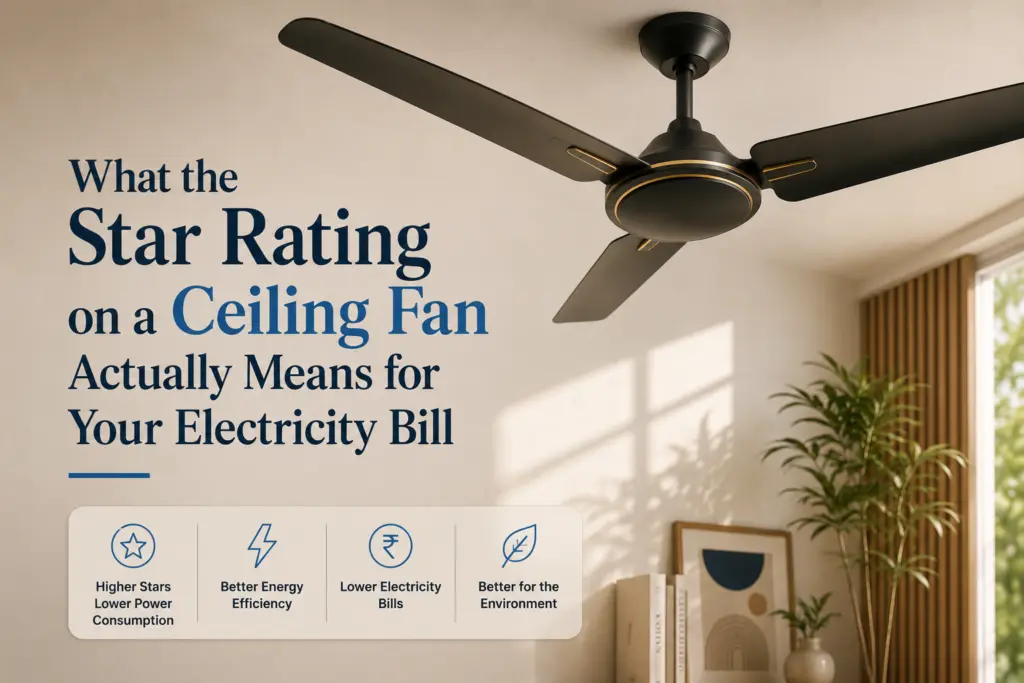
What the Star Rating on a Ceiling Fan Actually Means for Your Electricity Bill
 Blogs
Blogs
In a tropical country like India, ceiling fans are the unsung heroes of household comfort. They run almost continuously for eight to ten months a year, and in southern or coastal regions they practically never switch off. Because they operate non-stop in the background, we rarely think about how much power they consume, focusing instead on obvious energy hogs like air conditioners and refrigerators.
Yet a standard, older ceiling fan running in multiple rooms can quietly account for a large chunk of your monthly power costs. This is where the ceiling fan star rating from the Bureau of Energy Efficiency comes in. Here is a practical breakdown of the BEE rating system, the technology behind a 5 star fan, and how much an energy-efficient fan can actually save you.
1. Understanding Ceiling Fan Star Ratings
The bright blue and green star label on a ceiling fan box is not a marketing gimmick. It is a mandatory compliance sticker gby the Bureau of Energy Efficiency, a department under the Government of India.
- 1 star fan: consumes roughly 50W to 55W, basic efficiency.
- 3 star fan: consumes roughly 40W to 45W, mid-tier efficiency.
- 5 star fan: consumes roughly 28W to 35W, premium efficiency, usually BLDC technology.
The star system rates products from 1 to 5. A 1 star rating meets the bare minimum efficiency guidelines required to legally sell the product, while 5 stars represents peak energy efficiency for the same volume of air moved. BEE continuously tightens its performance metrics, so a fan that qualified for 5 stars a few years ago might only reach 3 stars under today’s stricter labelling guidelines. Ratings are calculated from the fan’s Service Value, the ratio of air delivery (cubic metres per minute) to power consumed (in watts). Simply put, a high ceiling fan star rating means maximum airflow using minimal electricity.

2. The Math: Standard Fan vs 5 Star Fan
To appreciate the value of an energy-efficient fan, consider a real-world calculation based on typical Indian household usage. Assume a household runs 3 ceiling fans for an average of 12 hours a day over roughly 300 active days a year, at an average residential electricity tariff of ₹8 per unit.
- Traditional induction fan (75W): 75W × 12 hours × 300 days × 3 fans = 810,000 Wh, or 810 units. At ₹8 per unit, that is an annual cost of about ₹6,480, or roughly 1 ceiling fan 1 hour unit costing a fraction of a rupee that adds up fast across a full year.
- Modern 5 star fan (28W): 28W × 12 hours × 300 days × 3 fans = 302,400 Wh, or 302.4 units. At ₹8 per unit, that is an annual cost of about ₹2,419.
The direct saving from upgrading to an energy-efficient fan setup works out to over ₹4,000 every year. Within 12 to 18 months, the fans effectively pay for themselves through reduced electricity bills.
A 5 star fan does not just carry a shinier label. Over a full year of near-continuous running, that label can be worth thousands of rupees back in your pocket.
3. What Makes a 5-Star Fan So Efficient
Manufacturers have managed to cut power consumption by more than 60 percent without reducing speed or blade size, largely by shifting from older induction motors to BLDC (Brushless Direct Current) motors.
Conventional fans use standard AC induction motors that rely on mechanical carbon brushes to transfer electricity, creating friction that heats up the motor and wastes electricity you pay for on your bill. A BLDC 5 star fan changes this by using permanent magnets and an electronic circuit board instead of brushes, eliminating mechanical friction almost entirely, so the motor stays cool to the touch while the internal circuit board dynamically converts incoming AC power to DC power, precisely managing the current needed to maintain speed.
4. Should You Pay the Premium
A standard induction fan typically costs ₹1,200 to ₹1,800, while a high-quality BLDC fan with a top ceiling fan star rating sits between ₹2,500 and ₹4,500. Orient’s 5-star BLDC models, for instance, generally fall within this same price band, so checking the current orient fan price list is a useful starting point when comparing options.
While the upfront cost is higher, skipping a 5-star fan to save a few hundred rupees initially is often a false economy. A ceiling fan is a long-term appliance that easily lasts 7 to 10 years, so an energy-efficient fan acts as an investment that pays compounding dividends on your electricity bill month after month.

5. Frequently Asked Questions
Q: What does a 5 star rating mean on a ceiling fan?
It means the fan delivers the Bureau of Energy Efficiency’s highest recognised airflow-to-power ratio, typically consuming 28W to 35W at peak speed compared to 50W or more for a 1 star fan.
Q: How much can a 5 star fan save on electricity bills?
For a typical 3-fan household running 12 hours a day, switching from a standard induction fan to a 5 star fan can save more than ₹4,000 a year.
Q: Why do BLDC fans qualify for higher star ratings?
BLDC motors use permanent magnets and an electronic circuit board instead of carbon brushes, which eliminates mechanical friction and cuts power consumption dramatically.
Q: Is a 1 star fan still legal to sell in India?
Yes, a 1 star rating meets the minimum efficiency standard required to legally sell a ceiling fan, though it is far less efficient than a 5 star model.
Q: How long does it take a 5 star fan to pay for itself?
Based on typical usage and electricity tariffs, most households recover the extra upfront cost within 12 to 18 months through lower electricity bills.
6. Conclusion
A higher ceiling fan star rating is not a marketing badge, it is a direct, calculable reflection of how much electricity a fan will draw over years of near-continuous use. For most Indian households running fans for most of the day, a 5 star or BLDC fan pays for its price premium within a year or two and keeps saving after that.