Projector vs TV for a Home Theatre: Which One Actually Suits Indian Living Rooms?
 Blogs
Blogs
Creating a home theatre is every movie lover’s dream, but the big decision is projector vs TV. Both promise a cinematic experience, yet Indian living rooms come with their own unique challenges around space, lighting, and budget.
Here is how projectors and TVs actually compare across the factors that matter most for everyday Indian homes.
1. Projector vs TV for Screen Size and Picture Quality
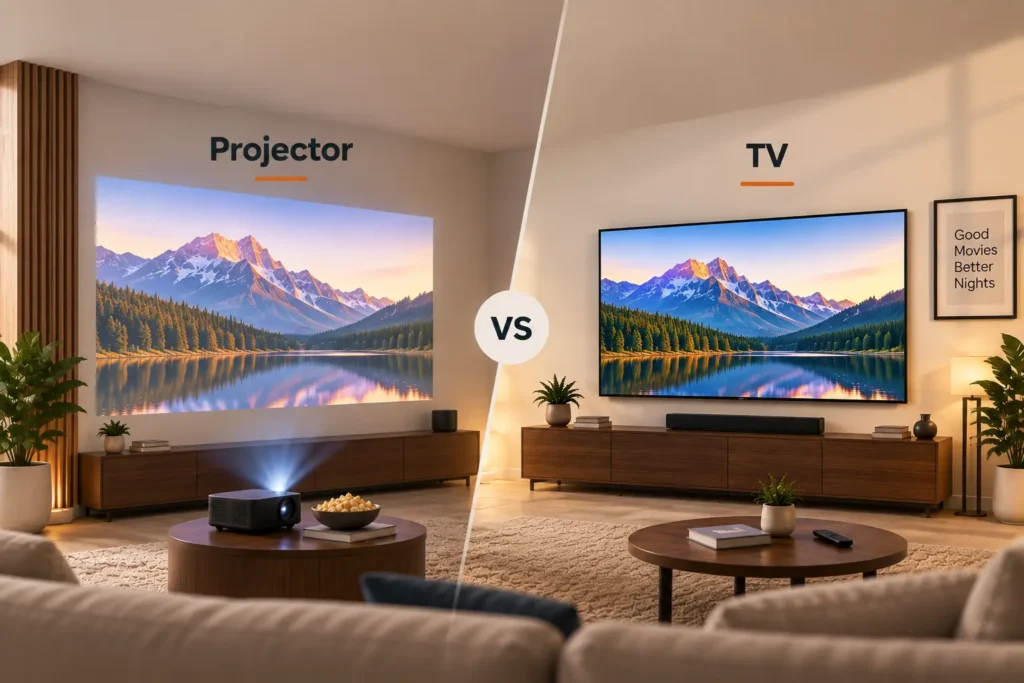
Many home projectors can produce images around 100 to 150 inches, depending on the projector, room size and setup, while standard large TVs typically range from 55 to 85 inches. Projectors have the advantage when sheer screen size is the priority, while TVs generally offer better sharpness and consistency.
Projector picture quality is more affected by ambient light and screen conditions, while TVs generally maintain more consistent brightness and contrast in brighter rooms. A 4K or OLED TV, by contrast, delivers crisp visuals regardless of lighting, making TVs the more reliable option for everyday viewing.
2. Space, Setup, and Sound
A projector typically needs suitable throw distance, a screen or suitable wall surface, and careful placement, while a TV usually requires less installation planning.
On sound, a projector usually needs external speakers for good audio, while a TV’s built-in speakers are decent on their own and can be paired with a soundbar if needed. TVs are more self-sufficient overall, while projectors demand some extra investment to sound as good as they look.
A projector wins on sheer size for the same budget. A TV wins the moment your room has bright daylight and no dedicated theatre space to control it.
3. Cost and Long-Term Durability
Projectors range from around 30,000 to 1,50,000 rupees depending on brightness and resolution, with added cost for a screen and speakers. Large 4K or OLED TVs range from about 40,000 to 2,00,000 rupees or more. Projectors deliver bigger screens for less money, while TVs cost more but arrive as a complete package.
Projector lifespan and maintenance depend on the light source. Traditional lamp-based models may require lamp replacement over time, while LED and laser projectors generally avoid regular lamp replacement.
4. The 2026 Living Room Reality
- Urban apartments: TVs dominate due to limited space and typically brighter room lighting.
- Luxury homes: projectors remain popular for dedicated theatre rooms with controlled lighting.
- Hybrid trend: many families use a TV for daily viewing and a projector for weekend movie nights.
5. Frequently Asked Questions
Q: Is a projector or TV better for a home theatre in India?
For most Indian living rooms with everyday lighting, a large 4K TV is more practical. For a dedicated dark room, a projector delivers a more genuine theatre experience.
Q: Does ambient light affect a home theatre projector?
Yes, significantly. Even high-end projectors struggle to look sharp in bright rooms, while TVs maintain picture quality regardless of lighting.
Q: Is a projector cheaper than a large TV for the same screen size?
Generally yes. Projectors can deliver a much larger image for less money than an equivalent large-screen 4K or OLED TV, though you need to add the cost of a screen and speakers.
Q: Do projectors need more maintenance than TVs?
Yes. Projector bulbs typically need replacing every 3 to 5 years and dust can affect performance, while TVs generally require minimal ongoing maintenance.
Q: Can I use both a TV and a projector at home?
Many households do exactly this, using a TV for daily viewing and a projector for weekend movie nights in a dedicated, darker space.
6. Conclusion
When it comes to projector vs TV, projectors deliver the big-screen thrill, but TVs offer consistent quality and everyday convenience. For most Indian living rooms, a large 4K TV remains the practical choice, while a dedicated dark room with a projector delivers a true theatre feel. Many households find the smartest move is a TV for everyday use and a projector reserved for cinematic weekends.
Having trouble setting up your projector or getting the right picture and sound? Get step-by-step help from an expert through a live video session and resolve the issue from home.