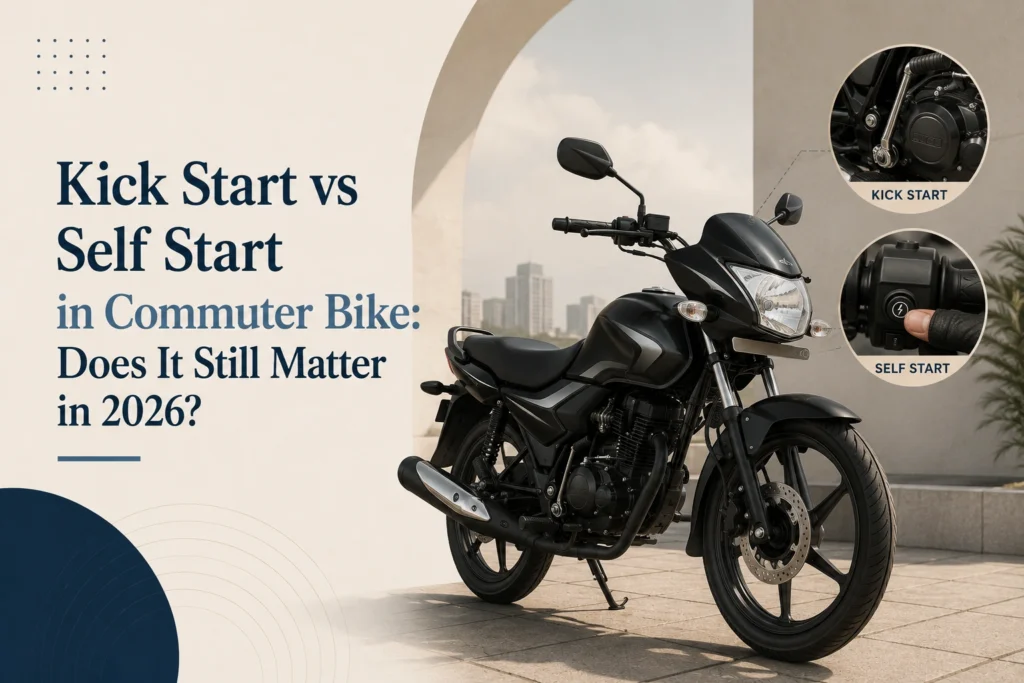
Kick Start vs Self Start in a Commuter Bike: Does It Still Matter in 2026?
 Blogs
Blogs
As of 2026, commuter bikes have advanced significantly, with newer models integrating sophisticated ignition systems. Even so, the debate between kick start and self start, the two fundamental ways to fire up a motorcycle, remains very much alive among Indian riders.
This guide breaks down the kick start vs self start bike debate in plain terms: the advantages and disadvantages of each mechanism, how relevant they still are for modern commuting, and what to weigh up before choosing between them.
1. Kick Start Mechanism: Pros, Cons and Best Use Cases
Bikes with kick start remain popular for a simple reason: there is very little that can go wrong with them. Here is how the mechanism stacks up.
Pros
- Cost-effective: kick start bikes are generally more affordable, making them a strong choice for budget-conscious buyers.
- Mechanical simplicity: fewer components means fewer things that can fail, which usually means lower maintenance costs.
- Durability: the simple design tends to be more robust and long-lasting over time.
Cons
- Physical effort: starting the bike takes leg strength, which can be tough in cold weather or for riders with physical limitations.
- Tiring in traffic: frequent stop-start city riding can make repeated kicking exhausting.
- Dated aesthetics: kick start bikes can lack the sleek look many modern riders prefer.
Best Use Cases
- Rural and rough terrain, where a simple mechanism is easier to keep running.
- Budget-conscious buyers who want an economical bike with minimal upkeep.
2. Self Start Mechanism: Pros, Cons and Best Use Cases
Self start (electric start) bikes trade mechanical simplicity for convenience, which is why they now dominate showroom floors.
Pros
- Ease of use: start the bike with a simple button press, no physical effort needed.
- Convenience: ideal for urban settings where quick starts save time.
- Modern aesthetics: usually paired with contemporary designs and extra features.
Cons
- Higher cost: self start bikes are generally pricier, and a replacement self starter motor price can run into a few thousand rupees when the unit eventually wears out.
- Complexity: more intricate mechanisms can mean higher maintenance requirements.
- Battery dependency: a weak or dead battery is the single most common reason a bike self start is not working, and it needs regular servicing or replacement.
Best Use Cases
- Urban areas, where riders need a quick, effortless starting routine.
- Long commutes, where convenience matters more than mechanical simplicity.
3. Technological Innovations Changing the Debate in 2026
Smart Start Systems
- Smartphone integration: some bikes now start via a companion app, adding another layer of convenience.
- Electric-assisted kick starters: a hybrid solution that reduces physical strain while keeping the mechanical simplicity of a kick start.
Battery Management Systems
Advanced battery management now extends battery life and reliability, directly addressing the self starting motor concerns that used to put buyers off electric start.
4. What Indian Buyers Are Prioritizing in 2026
- Eco-conscious buyers increasingly prefer bikes with fewer mechanical parts to reduce environmental impact.
- Demand for connected, tech-enabled features such as smart starters continues to grow.
- Design and brand reputation still play a major role in the final purchase decision.
5. Frequently Asked Questions
Q: Is kick start better than self start for a commuter bike?
Neither is universally better. Kick start wins on cost, simplicity and durability, while self start wins on convenience and ease of use, especially in city traffic.
Q: Why do some riders still prefer bikes with kick start?
Kick start bikes are cheaper to buy and maintain, mechanically simpler, and better suited to rural or rough terrain where quick, reliable repairs matter more than convenience.
Q: What usually causes a bike’s self start to stop working?
In most cases it is a weak or discharged battery. Corroded terminals, a faulty starter motor, or wiring issues can also stop the self start from engaging.
Q: Are hybrid kick-start and self-start systems available?
Yes. Some modern commuter bikes offer electric-assisted kick starters, combining mechanical simplicity with reduced physical effort.
Q: Which is cheaper to maintain, kick start or self start?
Kick start systems are generally cheaper to maintain because they have fewer parts. Self start systems add the ongoing cost of battery upkeep and occasional starter motor replacement.
6. Conclusion
In 2026, the kick start vs self start bike debate is less about which mechanism is objectively better and more about matching the bike to how and where you ride. Budget-conscious and rural riders still lean toward kick start for its simplicity and low upkeep, while urban commuters overwhelmingly favour the convenience of self start.