Soundbar for TV: Why Built-In TV Speakers Disappoint and What Changes
 Blogs
Blogs
You just brought home a brand-new 4K smart TV You just brought home a brand-new 4K smart TV, but a soundbar for TV may be what your setup is missing. It has a breathtaking display, razor-thin bezels, and vivid colours that make movies pop. You dim the lights, start an action film, and settle in. But the moment the dialogue begins, the excitement fades. The voices sound muffled. To hear what the actors are saying, you turn up the volume, only for a sudden explosion to blast through the room, forcing you to turn it right back down.
If this constant volume-remote dance sounds familiar, you are experiencing a common modern problem: built-in TV speakers are simply not very good. While display technology has leapt forward, built-in TV audio has, in many ways, gone backward.
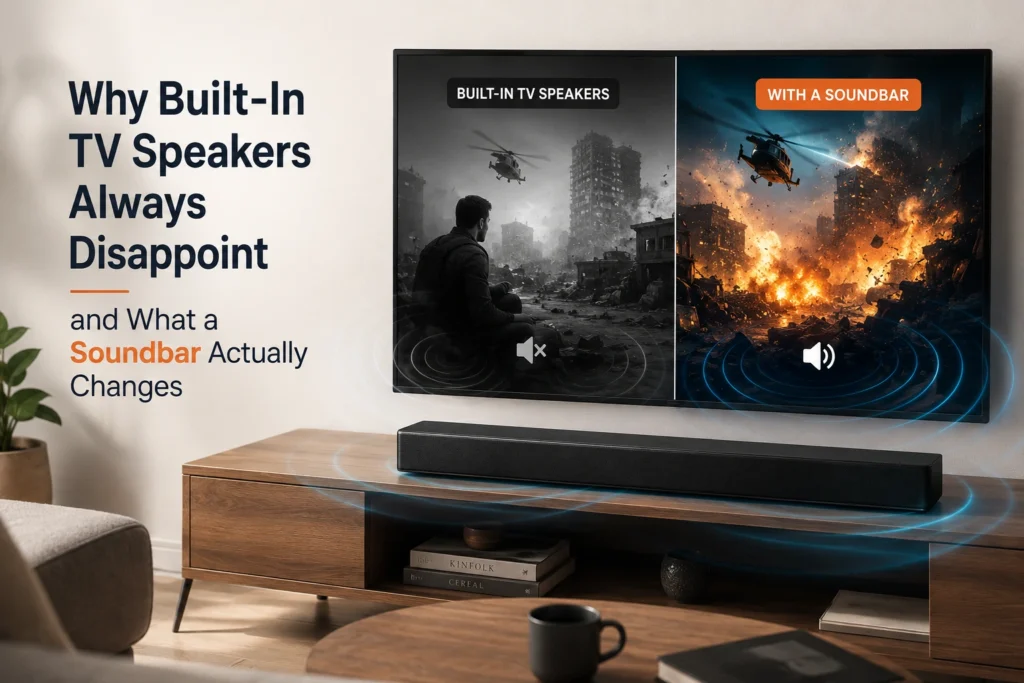
Choosing a soundbar for TV can change your home entertainment experience considerably. Here is a closer look at why modern television audio disappoints, and how a soundbar upgrade transforms what you hear.
1. The Physics Problem: Why Modern TV Speakers Disappoint
The primary reason built-in speakers sound flat comes down to physics and industrial design.
As consumers demanded thinner, sleeker televisions that sit flush against a living room wall, manufacturers had to make major structural compromises. Good sound needs physical space. To produce deep bass and rich mid-tones, an audio driver needs room to move air back and forth, and a speaker needs a hollow acoustic chamber, or enclosure, for sound waves to resonate properly.
Because modern televisions are often less than an inch thick, there is simply no room for substantial speakers. To work around this, manufacturers use small, underpowered audio drivers.
With no space left on the front bezel, these speakers typically end up in one of two configurations:
- Downward-firing: The speakers point directly at your TV console or the floor. The sound has to bounce off furniture before reaching your ears, resulting in a muddy, indirect sound
- Rear-firing: The speakers point directly at the wall behind the TV, causing sound waves to crash into the drywall and create echoes and rattling that hurt vocal clarity
The result is that high frequencies sound tinny, mid-tones, where human speech lives, get squashed, and low-end bass is barely present at all.
2. Soundbar for TV vs Built-In TV Sound: What Changes After the Upgrade
When comparing soundbar audio to built-in TV sound, the difference is immediately noticeable. A soundbar sidesteps the physical limitations of a flat-screen TV by moving the entire audio system into a dedicated, acoustically designed external unit.
A proper soundbar upgrade improves your home audio setup through three core engineering changes.
True Forward-Firing Audio Drivers
Instead of forcing sound to bounce off walls or a TV stand, a soundbar sits directly under your screen with its drivers pointed straight at your seating area. This direct path means high and mid-frequency sound waves reach your ears without losing clarity, sharpness, or detail.
A Dedicated Center Channel for Vocal Clarity
Standard television speakers split audio into basic left and right channels. When a movie scene has background music, ambient effects, and dialogue happening at once, these two channels get overwhelmed.
Most mid-range soundbars use a 3.1-channel setup. The “.1” represents a separate subwoofer, while the “3” stands for three internal speakers: left, right, and centre. The centre speaker is built to handle human dialogue specifically, so by separating speech from sound effects, you no longer need to keep raising the volume to follow a quiet conversation.
Deep Bass via an External Subwoofer
Low-frequency bass, like the rumble of an engine, the thump of electronic music, or a cinematic explosion, needs a large speaker cone to move a significant amount of air. A television simply cannot do this on its own. Most soundbars come bundled with a dedicated wireless subwoofer, and placing it on the floor introduces deep, cinematic bass that adds real immersion to movies, sports, and gaming.
3. The Hidden Tech: Virtual Surround Sound and Clear Voice Modes
Beyond the physical hardware improvements, a soundbar introduces smart digital signal processing that built-in TV software simply cannot replicate.
Modern soundbars come with decoding technology like Dolby Audio, Dolby Atmos, or DTS:X, and even budget-friendly models include smart processing modes such as:
- Dialogue or Clear Voice mode: Electronically isolates and boosts the frequencies of human speech while reducing background noise
- Night mode: Compresses the audio dynamic range, taming loud explosions and boosting quiet whispers, so late-night viewing stays clear without waking the household
- Virtual surround sound: Fires sound waves at precise angles that bounce off your living room walls, creating the impression of sound coming from behind and beside you
Investing in a high-end television but relying on its built-in speakers is a bit like buying a capable car and fitting it with the cheapest possible tyres. Most of the performance is left on the table.
4. Is a Soundbar for TV Worth the Upgrade?
Moving to an external audio system completes the picture. Whether you choose a compact, single-piece soundbar for a bedroom or a multi-speaker setup with a wireless subwoofer for your main living room, a soundbar closes the gap between a TV’s stunning visuals and genuinely immersive sound.
5. Frequently Asked Questions
Q: Why do built-in TV speakers sound worse than they used to?
As TVs have become thinner, manufacturers have had less physical space to fit proper speaker drivers and acoustic chambers, which limits bass response and pushes speakers into downward-firing or rear-firing positions that hurt sound clarity.
Q: What is the biggest difference a soundbar makes to TV audio?
The clearest difference is dialogue clarity, thanks to a dedicated centre channel, followed by deeper bass from an external subwoofer and forward-firing drivers that send sound directly toward your seating area instead of bouncing it off walls or furniture.
Q: Do I need a soundbar with a subwoofer?
A subwoofer is not mandatory, but it makes a noticeable difference for movies, gaming, and music by adding low-frequency bass that a soundbar’s main unit and a standard TV cannot produce on their own.
Q: Is a soundbar worth it for a small bedroom TV setup?
Yes. Even a compact, single-piece soundbar significantly improves dialogue clarity and overall sound compared to built-in TV speakers, without needing the space a full multi-speaker system would require.
Q: What is Clear Voice or Dialogue mode on a soundbar?
It is a processing mode that isolates and boosts the specific frequency range of human speech while dampening background music and effects, making conversations easier to follow without raising the overall volume.
6. Conclusion
Built-in TV speakers disappoint for a simple reason: modern television design leaves no physical room for good sound. A soundbar fixes this by moving audio into a dedicated, forward-facing unit with a proper centre channel and, in most cases, a wireless subwoofer for real bass. The upgrade is not just about volume, it is about finally hearing dialogue, music, and effects the way they were meant to be heard.