Orient Aero O2 Review: Is This Air-Purifying Ceiling Fan Worth ₹17,000?
 Blogs
Introduction
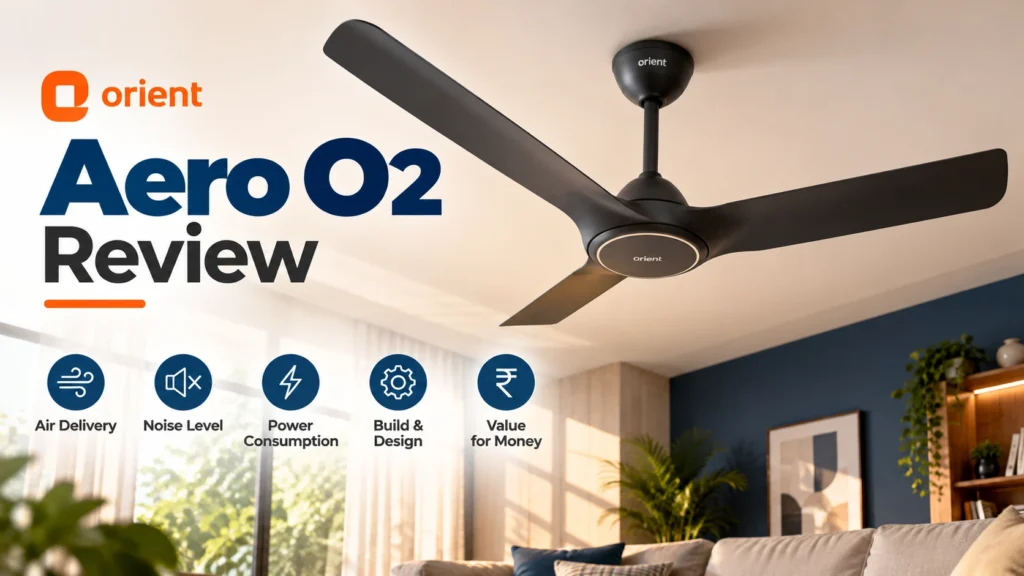
The Orient Aero O2 is a ceiling fan designed to do more than circulate air. It combines a BLDC motor, remote control and reverse mode with a plasma-ion module that Orient says can improve indoor air quality. This additional technology also makes the fan considerably more expensive than many conventional BLDC models.
At the time of checking, Orient’s official product page listed the Aero O2 at ₹17,083 against an MRP of ₹24,999. The company advertises oxygen enrichment, pollutant reduction and microorganism neutralisation alongside its conventional fan specifications. However, these air-quality claims need careful examination before buyers use them to justify the premium price.
There is an important development to know before buying. The Advertising Standards Council of India (ASCI) reviewed claims made for the Orient Aero O2 and upheld its decision that three prominent performance claims were inadequately substantiated and misleading by exaggeration. This does not automatically establish that every feature of the fan is ineffective, but it does mean buyers should not accept the advertised health-related benefits at face value. You can read the ASCI complaint decision for the detailed findings.
In this review, we examine the Orient Aero O2’s specifications, price, estimated electricity costs, comparison with a conventional BLDC fan, the ASCI findings and the questions buyers should ask before purchasing it.
1. Orient Aero O2 Specifications at a Glance
The following specifications are listed on Orient Electric’s official product page. The selling price may change.
| Specification | Orient Aero O2 |
|---|---|
| Product type | BLDC ceiling fan with plasma-ion module |
| Sweep size | 1200 mm |
| Motor power | 38W |
| Advertised air delivery | 250 CMM |
| Advertised maximum speed | 290 RPM |
| Control | Remote control |
| Reverse mode | Yes |
| Air-treatment feature | Plasma-ion technology |
| Star rating | 5-star rating, as listed by Orient |
| Weight | 6.4 kg |
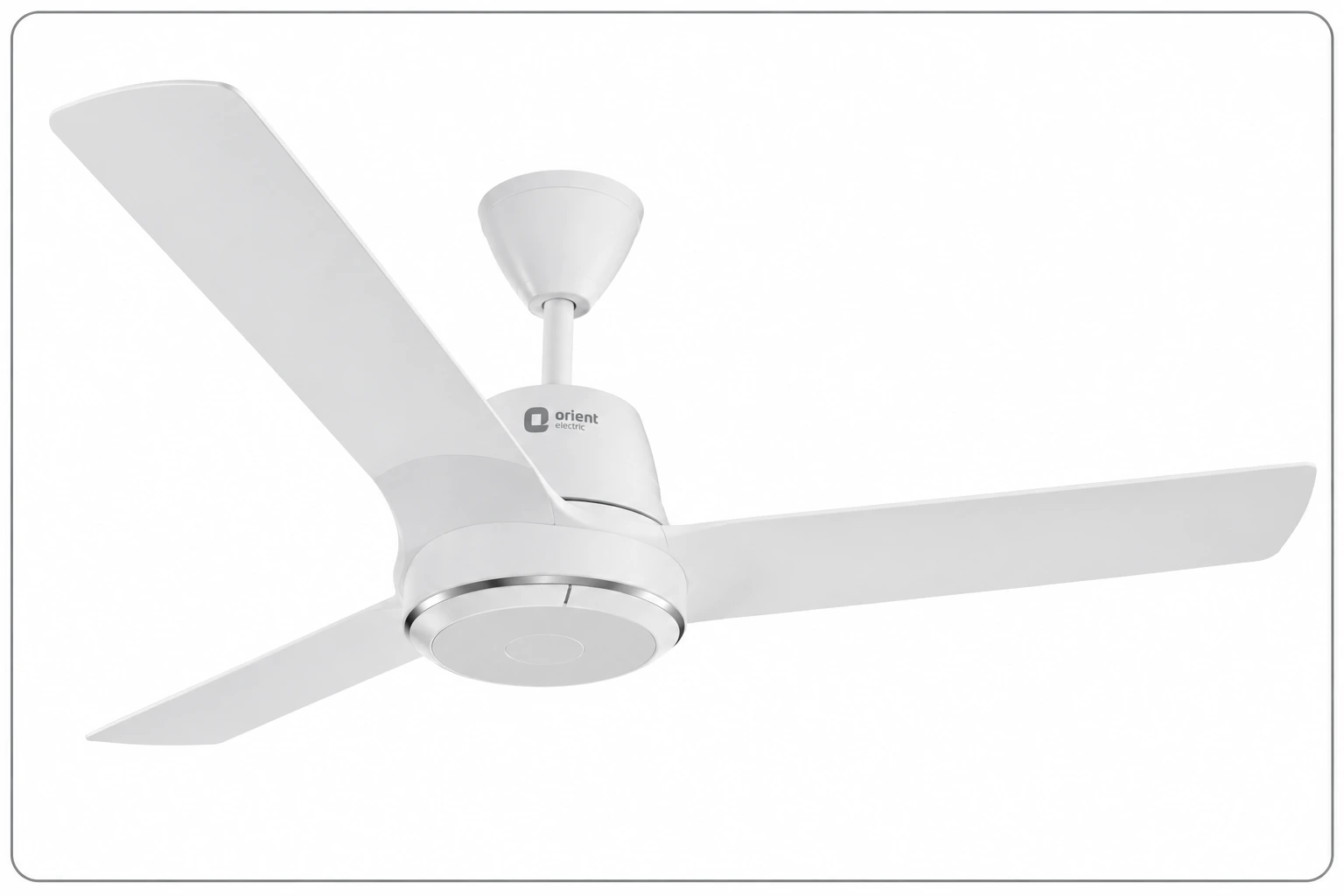
| Colour | White |
| Warranty | 3 years, as listed by Orient |
| Listed price | ₹17,083 |
| Listed MRP | ₹24,999 |
Source: Orient Aero O2 official product page.
The fan’s basic specifications make it comparable with other premium ceiling fans. Its main point of difference is the plasma-ion module and the air-quality benefits advertised by the manufacturer.
Those additional claims require separate scrutiny. A fan’s listed power consumption, speed and air delivery do not prove that its air-treatment system delivers the advertised health-related benefits.
2. What Is the Orient Aero O2?
The Orient Aero O2 combines conventional ceiling-fan operation with a plasma-ion air-treatment system. Its BLDC motor is rated at 38W, and the fan has a 1200 mm sweep size. It also includes a remote control and reverse mode.
The plasma-ion module distinguishes the Aero O2 from a conventional ceiling fan. According to Orient’s launch announcement, the technology uses active ions to break down certain pollutants and neutralise microorganisms. The company also promotes the product as an oxygen-enriching fan.
These are manufacturer descriptions of how the technology is intended to work. The important question is whether available evidence establishes the claimed performance under ordinary household conditions.
A ceiling fan circulates air around a room. A conventional air purifier is designed to reduce particular airborne contaminants through a defined method, such as mechanical filtration. An ionisation-based system works differently, and its effectiveness depends on its design, the contaminants being targeted and the testing method used to assess it.
The Aero O2 may offer useful fan features regardless of its air-treatment claims. Buyers should evaluate these two aspects separately rather than assuming that a premium ceiling fan necessarily performs like a dedicated air purifier.
3. What We Like About the Orient Aero O2
3.1 BLDC motor for everyday operation
The Orient Aero O2 uses a BLDC motor rated at 38W. BLDC ceiling fans are designed for energy-conscious operation and can be practical for households that run fans for several hours daily.
However, the Aero O2 is not the only fan offering this type of motor. Buyers should compare its rated power consumption with less expensive BLDC models before deciding whether the additional features justify the price.
3.2 Remote control and reverse mode
The remote control makes it easier to adjust fan settings without reaching for a wall regulator. Reverse mode provides another operating option for users who want to change the direction of air circulation in different conditions.
These are useful everyday features, although they are also available on other ceiling fans. They should be considered part of the Aero O2’s basic value rather than proof that its air-treatment technology works as advertised.
3.3 Advertised air delivery of 250 CMM
Orient lists the Aero O2’s air delivery as 250 CMM. This is a useful specification when comparing ceiling fans because it indicates the volume of air delivered under the relevant testing conditions.
The figure should still be considered alongside fan speed, motor power, noise and room conditions. Comparisons are most meaningful when different models have been assessed using comparable test methods.
The advertised figure is useful for shortlisting the fan, but it should not be confused with an independent measurement of its air-purification performance.
3.4 No conventional replacement filter advertised
Orient promotes the Aero O2’s plasma-ion system as a filter-free air-treatment solution. This may appeal to buyers who want to avoid recurring purchases of conventional replacement filters.
However, not having a replaceable filter does not automatically establish how effectively a device handles dust, gases or microorganisms. Buyers should check the manufacturer’s maintenance instructions and the evidence supporting its performance claims.
4. What Gives Us Pause About the Orient Aero O2?
The main concern is whether the advertised air-quality benefits justify paying a substantial premium over a conventional BLDC fan.
4.1 The price is considerably higher than that of many BLDC fans
At the listed price of ₹17,083, the Orient Aero O2 costs substantially more than many conventional BLDC ceiling fans.
That difference makes the air-treatment feature central to its value proposition. If you primarily want everyday cooling, remote control and energy-conscious operation, a less expensive model may be sufficient.
If you are paying extra specifically for oxygen enrichment or pollutant reduction, those benefits should be supported by convincing evidence relevant to normal home use.
4.2 ASCI found three prominent performance claims inadequately substantiated
The most important finding comes from ASCI’s complaint review concerning Orient Electric’s Aero O2.
The review examined the claims of “90% Oxygen Recovery in 8 Hours,” “99.99% Microbe Neutralisation” and “75% Less Toxic Gases.” ASCI’s Consumer Complaints Council Review panel concluded that these claims were inadequately substantiated and misleading by exaggeration. The earlier decision that the complaint was upheld remained in place following the review.
The panel raised concerns about the testing evidence, including whether the test conditions represented typical Indian homes, how the oxygen-recovery figure was calculated, which pollutants were affected and whether the results supported the advertised numerical outcomes. Concerns were also raised about the microorganism test setup and its relevance to normal household conditions.
This finding is more significant than simply not finding a laboratory report online. Supporting documents had been considered, but ASCI concluded that the evidence did not adequately substantiate the specific claims it reviewed.
The decision does not mean every specification of the Orient Aero O2 is false or that the fan cannot circulate air. It means buyers should be cautious about treating the disputed air-quality figures as proven outcomes.
5. Orient Aero O2 Air-Quality Claims: What Does the Evidence Say?
Orient’s official product page and launch announcement promote improvements in indoor air quality and oxygen enrichment. The marketing includes figures relating to oxygen recovery, toxic-gas reduction, microorganism neutralisation and improvements in the indoor air quality index.
The distinction between a manufacturer’s claim and an independently established result is particularly important here.
| Advertised claim | What buyers should know |
|---|---|
| Up to 90% oxygen recovery in eight hours | ASCI found the claim inadequately substantiated and raised questions about the calculation and testing conditions. |
| Up to 99.99% microorganism neutralisation | ASCI found the claim inadequately substantiated and raised concerns about the test setup and relevance to ordinary household conditions. |
| Up to 75% fewer toxic gases | ASCI found the claim inadequately substantiated, including concerns about the pollutants tested and the broad numerical claim. |
| Improvement in indoor air quality index | The manufacturer promotes this benefit, but the index, pollutants measured and test conditions need to be clearly established. |
| Oxygen enrichment within 15–20 minutes | This is a manufacturer-promoted benefit, not a guaranteed outcome established here for an ordinary room. |
| Coverage up to 1,000 sq. ft. | Buyers should check the basis of the coverage claim and whether the stated performance applies across that area. |
Sources: Orient Aero O2 product page, Orient launch announcement and ASCI decision.
The phrase “up to” matters because a maximum result under particular conditions does not guarantee the same result in every room. Similarly, a reduction in one selected pollutant does not establish that all indoor contaminants have been reduced.
For the Orient Aero O2, ASCI’s findings should be considered whenever these claims are discussed. It would be misleading to repeat the manufacturer’s numerical figures without explaining that the claims reviewed by ASCI were found inadequately substantiated.
6. Orient Aero O2 and the Ozone Question
Ionisation and other electronic air-cleaning technologies deserve careful evaluation because some devices can produce ozone as a by-product. Ozone can irritate the respiratory system, making emissions a relevant safety consideration for equipment intended to operate in occupied rooms.
The California Air Resources Board’s consumer guidance on air cleaners explains the health concerns associated with ozone. Its indoor air-cleaning device regulation sets an ozone-emission limit of 0.050 parts per million for devices within its scope.
That regulation is not proof that the Orient Aero O2 emits ozone. Equally, the absence of a verified product-specific result does not prove that the fan is unsafe or safe.
We could not establish a verified, product-specific ozone-emission result for the Orient Aero O2 from the sources reviewed for this article. Buyers concerned about this issue should ask Orient for relevant test results or applicable certification documentation before purchasing.
Ozone emissions and air-cleaning effectiveness are separate questions. Even when a device meets an applicable emissions standard, that alone does not demonstrate that it removes pollutants effectively.
7. Is the Orient Aero O2 Worth the Extra Money?
The answer depends on whether you need a conventional ceiling fan or are specifically interested in the additional air-treatment feature.
At ₹17,083, the Orient Aero O2 is priced well above many conventional BLDC fans. Its extra cost cannot be justified by the presence of a plasma-ion module alone. Buyers need to consider the evidence for its claimed benefits alongside the practical features of the fan.
7.1 Orient Aero O2 vs Atomberg Renesa+
The Atomberg Renesa+ is a useful comparison because it offers conventional BLDC fan operation without the same advertised plasma-ion air-treatment feature.
The following table uses the Orient product page and available retailer specifications. Prices are reference figures and should be checked again before publication.
| Feature | Orient Aero O2 | Atomberg Renesa+ |
|---|---|---|
| Fan type | BLDC ceiling fan with plasma-ion module | BLDC ceiling fan |
| Sweep size | 1200 mm | 1200 mm |
| Advertised air delivery | 250 CMM | 235 CMM |
| Rated power | 38W | 35W |
| Advertised maximum speed | 290 RPM | 360 RPM |
| Remote control | Yes | Yes |
| Air-treatment module | Plasma-ion technology | No equivalent feature identified in this comparison |
| Reference price | ₹17,083 on Orient’s website | Approximately ₹5,400 from a retailer listing |
Sources: Orient Aero O2 official product page, Atomberg Renesa+ at Croma and Atomberg Renesa+ at ToolBuy.
The Aero O2 has a higher advertised air-delivery figure in this comparison, while the Atomberg Renesa+ has a higher listed rotational speed and lower rated power consumption. These figures alone do not establish which fan will feel more comfortable in every room, and this is not a controlled performance test.
The main distinction is the Aero O2’s advertised air-treatment function. However, given ASCI’s findings on three prominent performance claims, buyers should be careful about paying the premium solely for the promised health-related benefits.
If you primarily want a BLDC fan with a remote control, the Atomberg Renesa+ or another conventional model may offer better value. If the Aero O2 interests you because of its air-treatment technology, examine the available evidence and the ASCI decision before making the extra investment.
7.2 Orient Aero O2 running cost
A fan’s rated power consumption is another useful comparison point. To estimate annual electricity costs, assume that each fan operates for eight hours per day and electricity costs ₹7 per kWh.
Calculation:
Annual electricity cost = Power in kW × Hours per day × 365 × Electricity rate
Using the rated wattages listed for these models:
| Fan | Rated power | Estimated annual consumption | Estimated annual electricity cost |
|---|---|---|---|
| Orient Aero O2 | 38W | 110.96 kWh | ₹777 |
| Atomberg Renesa+ | 35W | 102.20 kWh | ₹715 |
These are estimates, not measured electricity bills. Actual consumption depends on speed settings, operating hours, actual power draw and the applicable electricity tariff.
Under these assumptions, the Orient Aero O2 costs approximately ₹62 more per year to run than the Atomberg Renesa+. The difference in electricity costs is small compared with the upfront price difference.
Using the reference prices above, the Orient Aero O2 costs approximately ₹11,700 more. That premium is unlikely to be recovered through electricity savings based on these assumptions.
The Aero O2 therefore needs to justify its price through features you value and air-treatment benefits supported by credible evidence, not through running-cost savings alone.
Exploring More Products?
Still comparing options before making a purchase? Read more product reviews on GizmoSmart to explore features, compare alternatives and find the right product for your needs.
8. Who Should Consider Buying the Orient Aero O2?
The Orient Aero O2 may be worth considering if you want a BLDC ceiling fan with remote control, reverse mode and a distinctive additional feature.
It may suit buyers who:
- Want a ceiling fan with a 1200 mm sweep and remote control.
- Prefer a BLDC motor for everyday energy-conscious operation.
- Are interested in the concept of an integrated air-treatment system.
- Understand the difference between manufacturer claims and independently established performance.
- Have reviewed the ASCI findings and are comfortable making a decision based on the available evidence.
For these buyers, the plasma-ion module may be an interesting feature. However, the purchase should not depend on assuming that the fan will deliver a specific increase in oxygen or a particular reduction in pollutants under normal home conditions.
9. Who Should Skip the Orient Aero O2?
The Orient Aero O2 may not be the best choice for buyers whose main priorities are affordable cooling and energy efficiency.
If you simply need a ceiling fan with a remote control and a BLDC motor, compare lower-cost alternatives first. You may not need to pay a substantial premium for an additional air-treatment feature.
You should also avoid treating the Orient Aero O2 as a proven replacement for a dedicated air purifier if your main objective is reducing specific indoor pollutants. Choose air-cleaning equipment based on independently supported performance for the contaminants you need to address.
Finally, if you are primarily interested in the fan’s advertised oxygen-enrichment or pollutant-reduction benefits, consider the ASCI decision carefully. The numerical claims reviewed by ASCI were found inadequately substantiated, so they should not be the sole basis for your purchase.
10. Questions to Ask Before Buying the Orient Aero O2
Before purchasing, consider asking Orient Electric or the retailer these important questions:
- Can the company provide complete test reports for the advertised oxygen-recovery, microorganism-neutralisation and pollutant-reduction claims?
- Do the test reports demonstrate performance under ordinary household conditions?
- Are product-specific ozone-emission test results or relevant certification documents available?
- What maintenance does the plasma-ion module require over the product’s lifetime?
- What does the warranty cover, including the motor, electronics and air-treatment module?
Clear answers will help you separate the product’s documented capabilities from claims that have not been adequately substantiated.
11. Frequently Asked Question
Is the Orient Aero O2 worth ₹17,083?
It depends on what you need. The fan offers a BLDC motor, remote control, reverse mode and a plasma-ion module. However, its premium price is difficult to justify on the basis of the advertised air-quality benefits alone, particularly because ASCI found three prominent performance claims inadequately substantiated. Compare it with less expensive BLDC fans before deciding.
Can the Orient Aero O2 replace an air purifier?
You should not assume that it can. A ceiling fan circulates air, while an air purifier is designed to reduce specific airborne contaminants using a defined treatment method. The Aero O2’s air-treatment performance should be assessed using credible evidence before considering it a substitute for a dedicated purifier.
Does the Orient Aero O2 increase oxygen levels?
Orient advertises oxygen-recovery benefits, but ASCI found its “90% Oxygen Recovery in 8 Hours” claim inadequately substantiated. The panel raised questions about the calculation and whether the testing conditions represented normal household use. Buyers should not treat the advertised figure as a guaranteed outcome.
Does the Orient Aero O2 neutralise 99.99% of microorganisms?
That is one of the manufacturer’s advertised claims. ASCI found the “99.99% Microbe Neutralisation” claim inadequately substantiated and raised concerns about the test setup and its relevance to ordinary household conditions. The figure should not be presented as a proven real-world result.
Does the Orient Aero O2 reduce toxic gases?
Orient advertises reductions in certain toxic gases. However, ASCI found the “75% Less Toxic Gases” claim inadequately substantiated. Buyers should review the available evidence rather than assuming that the fan will achieve this reduction in their homes.
12. Our Verdict: Is the Orient Aero O2 Worth Buying?
The Orient Aero O2 combines a BLDC ceiling fan with remote control, reverse mode and a plasma-ion module intended to improve indoor air quality. Its basic fan features make it worth comparing with other premium ceiling fans, but its air-treatment claims need much more careful consideration.
At the listed price of ₹17,083, the Orient Aero O2 costs significantly more than many conventional BLDC models. Its additional technology is the main reason to consider paying that premium. However, ASCI’s review found the claims of “90% Oxygen Recovery in 8 Hours,” “99.99% Microbe Neutralisation” and “75% Less Toxic Gases” inadequately substantiated and misleading by exaggeration.
That finding does not establish that the fan’s conventional functions are ineffective. It does mean buyers should not treat the advertised numerical air-quality benefits as proven outcomes under ordinary household conditions.
For buyers who primarily want cooling, remote control and energy-conscious operation, a less expensive BLDC fan is likely to offer better value. For buyers interested in the Aero O2’s air-treatment technology, the sensible approach is to examine the ASCI decision, ask for the relevant technical documentation and avoid assuming that the product replaces a dedicated air purifier.
Our recommendation: Consider the Orient Aero O2 for its conventional fan features, but do not pay the premium solely for its advertised oxygen-enrichment or air-purification benefits. Given ASCI’s findings, those claims should be treated cautiously rather than as established performance.