Does Room Size Actually Change Which Soundbar You Should Buy?
 Blogs
Blogs
Scrolling through soundbar reviews online, you will find glowing praise for the exact same model alongside complaints that it sounds weak or hollow. The missing variable in most of these conflicting opinions is room size. A soundbar that sounds phenomenal in a small bedroom can sound thin and underpowered in a large, open-plan living room.
Before you pick a soundbar based on price or channel count alone, understanding how room dimensions affect sound performance will save you from a mismatched purchase and a disappointing home theatre experience.
1. Why Room Size Changes How a Soundbar Performs
Sound waves behave differently depending on the space they travel through. In a small room, walls are close together, so sound reflects quickly and builds up volume and bass naturally, meaning even a modest soundbar can fill the space with rich, booming audio. In a large room, sound waves travel further before hitting a surface, dispersing energy across a bigger area and requiring significantly more power and better speaker dispersion to maintain the same perceived volume and clarity.
2. Matching Soundbar Power and Configuration to Room Size
Small Rooms (Under 150 Square Feet)
A compact 2.0 or 2.1 channel soundbar with a small subwoofer performs excellently here. Because the room naturally reinforces bass and volume, an overly powerful system can actually sound overwhelming or muddy in tight quarters.
Medium Rooms (150 to 300 Square Feet)
This is the most common living room size in Indian homes, and a 3.1 or 5.1 channel soundbar strikes the right balance, offering dedicated centre-channel clarity for dialogue and dedicated surround channels without requiring excessive power.
Large or Open-Plan Rooms (Over 300 Square Feet)
Larger spaces need higher wattage output and wider speaker dispersion to avoid sound feeling thin or distant from the seating area. A 5.1 channel soundbar with a more powerful wireless subwoofer, or even a system with additional rear surround speakers, ensures sound fills the entire room evenly rather than concentrating near the television.
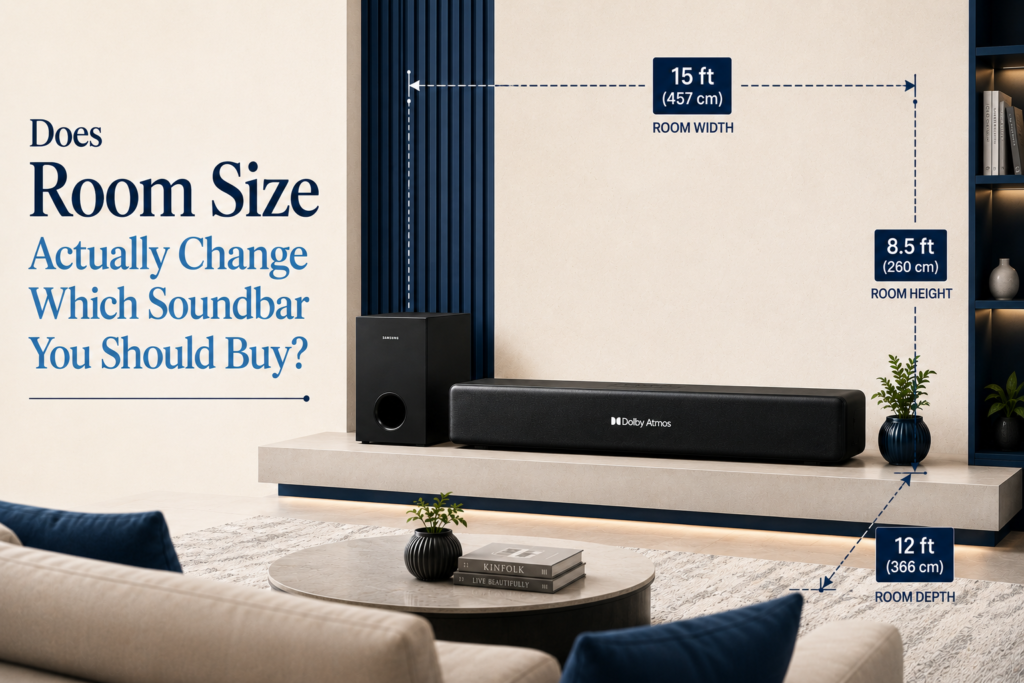
A soundbar that sounds rich and full in a small bedroom can feel thin and distant in a large open-plan living room. Room size, not just wattage, decides whether a it actually satisfies.
3. Beyond Square Footage: Ceiling Height and Furnishing
- High ceilings absorb and disperse sound energy upward, often requiring more power than square footage alone would suggest.
- Heavily furnished rooms with thick carpets, curtains and upholstered furniture absorb sound, softening excessive echo but also reducing overall perceived volume, which may call for a slightly more powerful system.
- Sparse rooms with hard floors, bare walls and minimal furniture reflect sound more, which can make even a modest soundbar feel louder and more resonant than expected.
4. Frequently Asked Questions
Q: Does room size really affect soundbar performance?
Yes. Sound waves reflect and build volume more easily in small rooms, while larger rooms disperse energy across more space and need more power to sound equally full.
Q: What soundbar configuration is best for a small bedroom?
A compact 2.0 or 2.1 channel soundbar with a small subwoofer usually performs excellently, since small rooms naturally reinforce bass and volume.
Q: What soundbar setup works best for a large living room?
A 5.1 channel soundbar with a powerful wireless subwoofer, or additional rear surround speakers, helps sound fill a large or open-plan space evenly.
Q: Do furnishings affect how a soundbar sounds in a room?
Yes. Heavily furnished rooms with carpets and curtains absorb sound and reduce echo, while sparse rooms with hard floors reflect more sound and can feel louder.
Q: Can an overly powerful soundbar sound bad in a small room?
Yes. In tight spaces where sound naturally builds up, an overly powerful system can sound overwhelming or muddy rather than clear.
5. Conclusion
Matching your soundbar’s power and channel configuration to your room’s actual size, ceiling height and furnishing prevents the common mismatch between a soundbar’s specs and how it truly sounds in your home.