Best Ceiling Fans for High and False Ceilings: What Changes When the Fan Hangs Lower?
 Blogs
Blogs
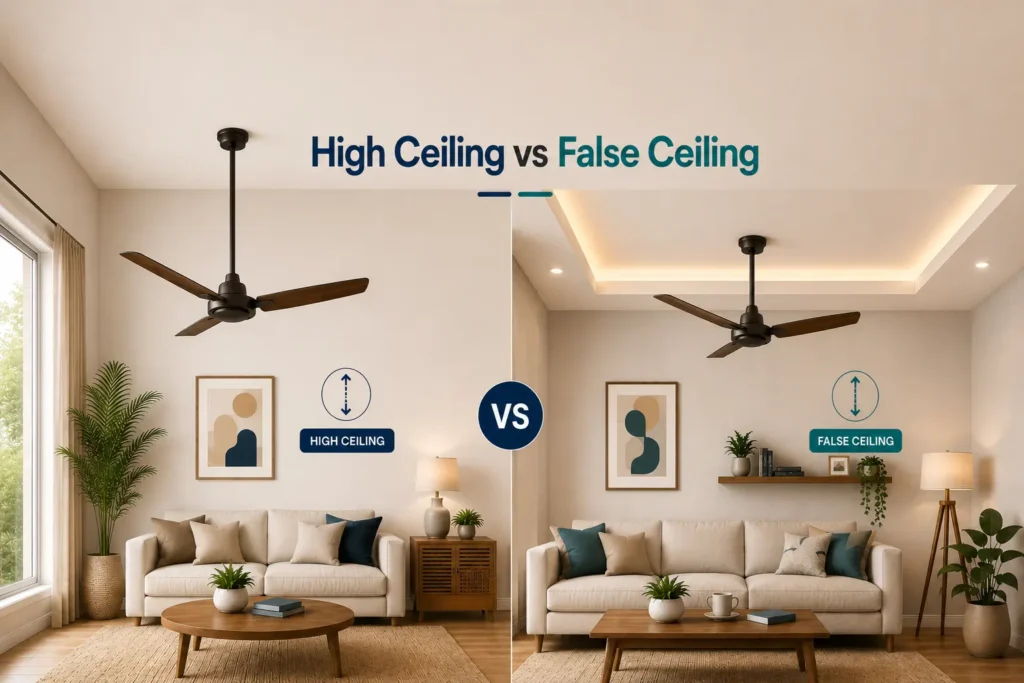
Ceiling fans are a staple in Indian homes, but ceiling fan height can make a significant difference to airflow and comfort. High ceilings and false ceilings each present unique challenges for airflow, which raises a genuine question: does hanging a fan lower actually change the cooling experience?
Here is how fan placement affects performance in these two scenarios, and which types of fans are best suited to each.
1. The Science of Airflow at Different Heights
At a standard ceiling height of 9 to 10 feet, a fan mounted directly provides optimal airflow. On high ceilings of 12 to 15 feet, a fan mounted too far up reduces the breeze actually felt at seating level. On false ceilings, the lowered surface can restrict airflow if the fan blades sit too close to it. In every case, the correct drop height is what determines maximum air circulation.

2. Downrods and Extensions
A downrod’s job is to lower the fan to the ideal height, typically 8 to 9 feet from the floor. High ceilings usually require longer downrods, often 12 to 24 inches or more, to bring the fan down to that ideal zone. False ceilings need shorter downrods instead, so the blades do not risk hitting the lowered surface. Choosing the right downrod length is genuinely critical for getting the airflow you expect.
The right downrod is not a cosmetic choice. Get the drop height wrong on a high or false ceiling, and even a powerful fan will barely be felt in the room.
3. How Ceiling Fan Height Affects Airflow
When the ceiling fan height is to high, air dissipates before it reaches the people in the room, resulting in weaker cooling. At the optimal height, the breeze is felt directly and circulation improves noticeably. If a fan hangs too low, it can create safety issues and reduced efficiency due to turbulence. Lowering a fan to the right level, not just any level, is what actually improves comfort.
4. Best Fan Types for High and False Ceilings
- BLDC fans: energy-efficient and able to maintain strong airflow even with longer downrods.
- Large sweep fans (1400mm): better suited to bigger rooms with high ceilings.
- Low-profile fans: designed specifically for false ceilings, staying compact and safe.
- Designer fans: blend aesthetics with performance, well suited to modern interiors.

5. Installation and the 2026 Ceiling Reality
For high ceilings, ensure a sturdy downrod and proper anchoring. Use reinforced mounts to avoid vibration and noise, and always maintain at least 7 feet of clearance from the floor to the blade tips for safety.
In urban apartments, where false ceilings are common, low-profile BLDC fans tend to dominate. In luxury homes with high ceilings, large sweep fans with extended downrods are the norm. Regardless of ceiling type, BLDC models continue to save around 60 percent on electricity compared to standard motors.
6. Frequently Asked Questions
Q: Does hanging a ceiling fan lower actually improve airflow?
Yes, when it brings the fan to the ideal height of 8 to 9 feet from the floor. Too high and air dissipates before reaching you, too low and it creates safety and turbulence issues.
Q: What downrod length do I need for a high ceiling?
High ceilings of 12 to 15 feet typically need downrods of 12 to 24 inches or more to bring the fan down to an effective height.
Q: Can I install a regular ceiling fan on a false ceiling?
It is better to use a low-profile fan designed for false ceilings, paired with a shorter downrod and reinforced mounts to avoid vibration and noise.
Q: What is the best ceiling fan size for a large room with high ceilings?
A large sweep fan, such as a 1400mm model, paired with an appropriate downrod, covers bigger rooms with high ceilings more effectively.
Q: How much clearance should there be between the floor and ceiling fan blades?
At least 7 feet of clearance from the floor to the blade tips is recommended for safety.
7. Conclusion
Ceiling fan height genuinely changes airflow. High ceilings need longer downrods, while false ceilings call for compact, low-profile designs. The smartest choice balances sweep size, energy efficiency, and safe installation, and for most modern homes, a BLDC fan with an appropriately sized downrod is the best solution for both ceiling types.