Microwave vs Oven: What’s the Difference and Which One Should You Choose
 Blogs
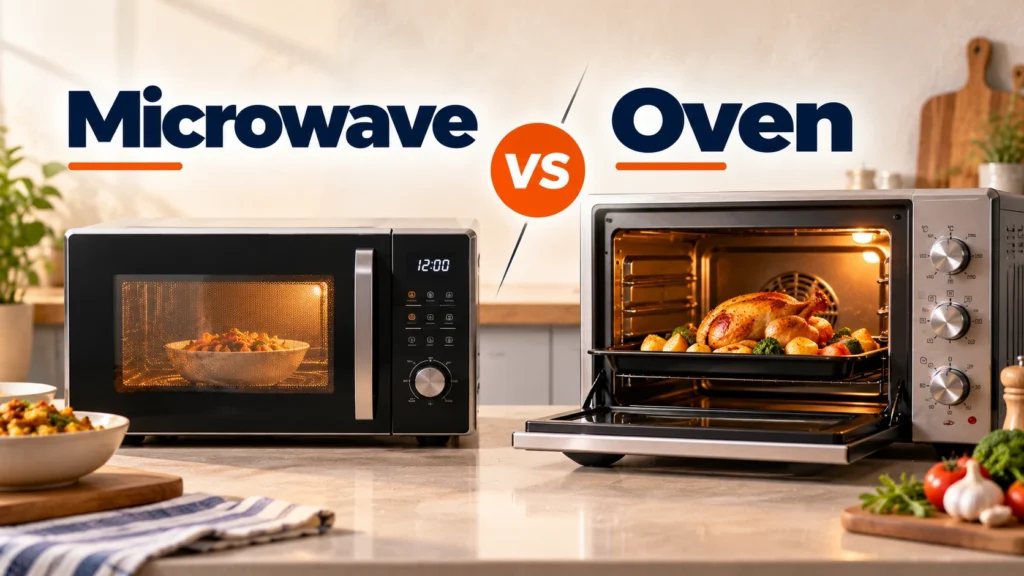
Setting up a kitchen often means weighing a microwave against an oven. Both heat and cook food, but they’re built for different jobs. Understanding the microwave vs oven difference makes it much easier to pick the one that actually fits how you cook.
From reheating leftovers to baking a cake, here’s how the two compare.
1. What Is a Microwave?
A microwave oven uses electromagnetic waves to heat food quickly. It’s especially useful for reheating cooked meals, warming beverages, defrosting frozen food, and preparing ready-to-cook dishes. Many modern models add preset cooking programs, auto-defrost, and multiple power levels. If fast heating and everyday convenience are your priority, a microwave fits well.
2. What Is an Oven?
An oven cooks food using heat from its elements or heating system, and depending on the type, it can bake, roast, and grill a wide variety of dishes. It’s particularly useful where controlled, consistent heat matters, like cakes, bread, pizzas, roasted vegetables, and baked dishes. Ovens come in different forms too, including conventional ovens, OTGs, and convection ovens.
3. Microwave vs Oven: Key Differences
When comparing microwave vs oven performance, consider the cooking tasks you do most often.
Cooking speed
Microwaves are generally faster for reheating and simple cooking tasks. An oven needs preheating and takes longer overall.
Baking
If baking cakes, cookies, bread, or similar items is a priority, an oven is usually the better pick. Some convection microwaves can bake too, but results depend heavily on the model.
Reheating
For reheating leftovers, rice, curries, and beverages, a microwave is generally the more convenient option.
Browning and crisping
An oven is better suited to creating a browned or crisp surface on food. Microwave models with grill or convection functions can get closer to this, but a dedicated oven usually wins.
Energy and convenience
For short reheating tasks, a microwave is more convenient because it heats quickly. An oven can consume more time and energy when preheating and cooking larger dishes.
4. Which One Should You Choose?
Your choice in the microwave vs oven comparison depends on your cooking habits, available kitchen space, and budget.
Choose a microwave if:
- You frequently reheat food
- You want quick cooking and defrosting
- You have limited kitchen space
- Convenience is your main priority
- You mainly prepare simple or ready-to-cook meals
Choose an oven if:
- You enjoy baking cakes, bread, cookies, or pizzas
- You regularly roast or grill food
- You want better browning and crisping
- You prepare larger meals
- Baking and cooking from scratch matter to you
5. What About a Convection Microwave?
A convection microwave combines microwave heating with convection cooking, and sometimes grilling, depending on the model. It can be a useful middle ground for kitchens with limited space that still want some oven-like versatility. Dedicated ovens, though, are usually still the better choice for people who bake frequently or cook in large quantities.
If you’re also considering an air fryer for your kitchen, read our guide on whether an air fryer can replace a microwave. It explains which appliance is more practical for reheating different foods and everyday cooking.
6. Frequently Asked Questions
What is the main difference between a microwave and an oven?
A microwave uses electromagnetic waves for quick heating and reheating, while an oven uses direct heat from its elements, better suited to baking, roasting, and grilling.
Can a microwave replace an oven for baking?
A convection microwave can bake to some extent, but results vary by model. A dedicated oven generally gives more consistent baking results.
Which is better for reheating food, a microwave or an oven?
A microwave is faster and more convenient for reheating leftovers, rice, curries, and beverages.
Is an oven more energy-consuming than a microwave?
For short tasks, yes, since an oven needs preheating. For larger baking or roasting jobs, the time an oven takes is part of the trade-off for better results.
Should I buy both a microwave and an oven?
If you both reheat food often and bake or roast regularly, having both appliances, or a convection microwave as a space-saving middle ground, covers more of your cooking needs.
7. Conclusion
In the microwave vs oven comparison, a microwave is excellent for quick heating, reheating, and everyday convenience, while an oven suits baking, roasting, grilling, and recipes that need controlled dry heat. Before buying either, compare capacity, cooking modes, power, dimensions, energy consumption, and warranty against your actual cooking habits.