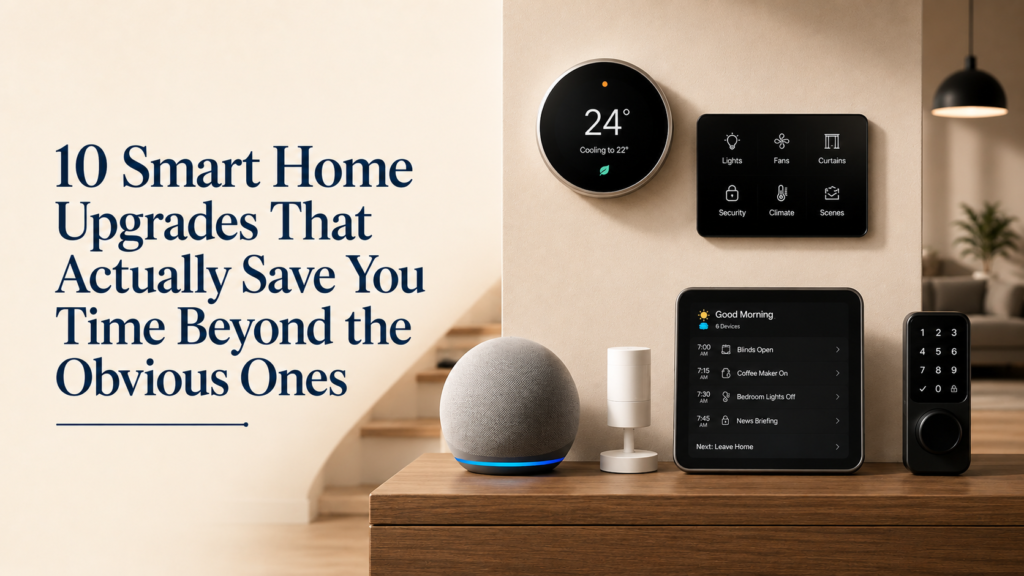
10 Smart Home Upgrades That Actually Save You Time Beyond the Obvious Ones
 Blogs
Blogs
When most people think of home automation, they picture the usual entry-level gadgets: a smart bulb that changes colour, or a voice assistant that reads out the weather forecast. While these entry-level smart home devices offer a fun novelty factor, they rarely shave meaningful minutes off your busy daily routine. Turning on a light switch with your smartphone instead of your finger is not a true efficiency breakthrough.
The real power of smart home upgrades lies in building automated ecosystems that eliminate repetitive, mundane household chores. The best home automation devices are the ones that work silently behind the scenes, taking over tasks you would rather not think about. If you are looking to optimise your daily routine, here are 10 smart home upgrades worth making that go far beyond the basic setup to reclaim your valuable hours.
Table of Contents
1. 10 Smart Home Upgrades That Actually Save You Time
2. How to Automate Your Home Step by Step
3. Frequently Asked Questions
4. Conclusion
1. 10 Smart Home Upgrades That Actually Save You Time
1. Smart Water Heaters (Geysers) with Scheduler Tech
Waiting 15 minutes for your bathroom geyser to heat up water during winter morning rush hours is a drain on your schedule. Replacing it with a smart geyser, or adding a smart heavy-duty switch plug, lets you set a strict daily schedule so your water is hot and waiting the exact minute your alarm goes off, saving a quarter of an hour every single morning.
2. Dual-Zone Air Fryers with Sync-Finish Programming
Preparing a complete meal often means cooking components in stages to prevent half the plate from going cold. Upgrading to a dual-basket air fryer lets you cook completely separate items at different temperatures simultaneously, with the system automatically calculating the time difference so both components finish cooking at the exact same moment.
3. Smart Locks with Auto-Unlock Proximity Geofencing
Fumbling around in deep pockets or bags for door keys while carrying heavy groceries is an everyday annoyance. A premium smart door lock uses your smartphone’s GPS geofencing so the door automatically unlocks as you walk up the driveway, eliminating the daily hassle of keys.
4. Continuous-Feed Tabletop Wet Grinders
Traditional batch grinding forces you to stand directly over a mixer grinder, adding water step by step and monitoring thick lentil batters manually. Upgrading to a dedicated tabletop wet grinder lets you pour in your soaked rice and walk away, since the machine handles the crushing and aeration independently, freeing up 20 minutes for other meal prep.
5. Smart Motorized Curtain and Blinds Controllers
Walking around a large home to manually pull down every window blind as the afternoon sun flares can become tedious. Integrating motorized curtain tracks lets you automate your windows based on real-time weather conditions or pre-set times, keeping your home insulated automatically.
6. BLDC Fans with Adaptive Smart Sleep Timers
Waking up shivering at 3 AM because the night air cooled down forces you to stumble over to a wall switchboard. A smart BLDC fan uses thermal sensors to monitor ambient room temperature, automatically dropping its speed step by step as the night cools to protect your sleep cycle.
7. Robotic Vacuum-Mops with Active Auto-Empty Docks
A standard robot vacuum often requires you to manually empty its tiny dustbin after every cleaning cycle, adding a new chore to your list. Upgrading to a model with an active auto-empty dock lets the vacuum clean, mop, wash its own pads, and dump its dirt completely hands-free for up to 60 days.
8. App-Controlled Reverse Osmosis Water Purifiers
Monitoring a slow-filling countertop container or guessing when internal filtration membranes are worn out creates unnecessary mental overhead. Smart purifiers track water metrics and your daily consumption via an app, sending a direct alert only when it is time to change a filter.
9. Smart Watering Valves with Soil Moisture Sensors
Setting manual lawn sprinkler timers can result in overwatering on rainy days, damaging your plants. Smart hose timers monitor real-time hyper-local weather forecasts and soil hydration levels, automatically skipping scheduled watering cycles if rain is on the horizon.
10. Automated Smart Power Strips for Idle Tech
Manually walking around the living room entertainment centre to unplug multiple devices like TVs, soundbars and gaming consoles to prevent phantom power draw takes time. Smart power strips sense when your primary TV is switched off and instantly cut power to all connected audio-visual gear automatically.
The best smart home upgrades are not the ones you notice every day. They are the ones that quietly take a chore off your list before you even think about it.
2. How to Automate Your Home Step by Step
If you are eager to implement these home automation ideas, avoid buying random gadgets all at once. Follow this practical blueprint instead.
- Phase 1, secure the backbone: install a high-bandwidth Wi-Fi router capable of handling multiple connected devices without lag.
- Phase 2, establish the hub: choose one ecosystem, such as Apple Home, Google Home, or Alexa, to tie all your devices together under a single app.
- Phase 3, upgrade for time: prioritise high-impact zones first, such as smart locks, geysers, or robotic vacuums, before adding smaller convenience gadgets.
3. Frequently Asked Questions
Q: What are the best home automation devices that actually save time?
Devices that eliminate repetitive chores entirely, such as scheduler-based geysers, auto-empty robot vacuums, geofenced smart locks, and app-controlled water purifiers, save far more time than novelty gadgets like colour-changing bulbs.
Q: How do I start automating my home without wasting money on random gadgets?
Start by securing a strong Wi-Fi backbone, then choose one ecosystem like Apple Home, Google Home, or Alexa, and prioritise high-impact zones such as locks, geysers, or vacuums before adding smaller devices.
Q: Do smart locks with geofencing actually work reliably?
Yes. They use your smartphone’s GPS to detect when you approach your home and can automatically unlock the door, removing the daily hassle of digging for keys.
Q: Are dual-basket air fryers worth it for daily cooking?
For households that regularly cook multi-component meals, yes, since they let you cook separate dishes at different temperatures that finish at the same time, rather than cooking in stages.
Q: What is the most time-saving smart home upgrade for mornings?
A scheduler-enabled smart geyser is one of the highest-impact upgrades, since it ensures hot water is ready the exact minute your alarm goes off instead of making you wait.
4. Conclusion
Investing your budget into smart home devices beyond the basics shifts technology away from simple remote control toys and transforms your house into an active assistant that handles daily chores effortlessly.
Compare smart home devices and automation ecosystems on Livora to plan your next upgrade.