Which Display Is Best for Smartwatch? AMOLED vs LCD: What’s the Difference?
 Blogs
Blogs
Choosing a smartwatch isn’t just about its features, design, or battery life. The display also plays a big part in how the watch feels to use every day.
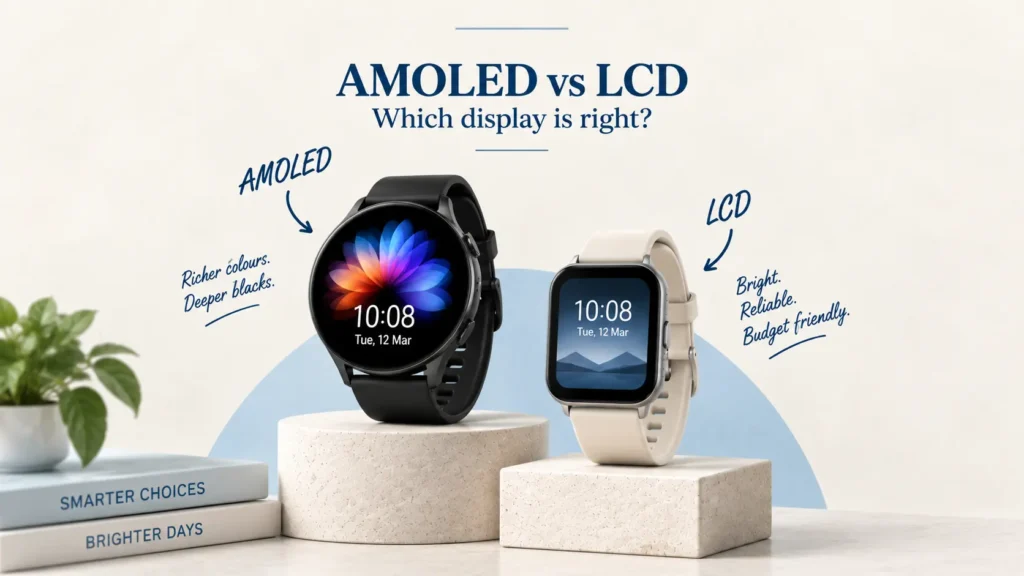
So, which display is best for a smartwatch? AMOLED and LCD are two common options, but they offer a noticeably different viewing experience. AMOLED displays are known for deeper blacks, richer colours, and stronger contrast, while LCD displays can offer good everyday visibility at a more affordable price.
The better choice depends on what matters to you, from display quality and outdoor visibility to battery life and budget. Let’s look at how AMOLED and LCD differ and which one makes more sense for your smartwatch.
1. AMOLED Smartwatch Displays: What Makes Them Different?
AMOLED displays are commonly found on mid-range and premium smartwatches, and there’s a good reason for that. Each pixel produces its own light, which means the display can turn individual pixels completely off when showing black.
In everyday use, this gives AMOLED screens deeper blacks, stronger contrast, and more vibrant colours. Watch faces, photos, animations, and colourful app screens also tend to look more striking.
Another advantage is that AMOLED displays can be more power-efficient when showing darker content because pixels displaying black can remain switched off. How much battery you actually save, however, depends on the watch, software, brightness, and how you use it.
2. LCD Smartwatch Displays: Are They Still a Good Choice?
LCD displays use a backlight to illuminate the screen rather than having each pixel produce its own light. They have been used in smartwatches for years and can still provide a clear and practical viewing experience.
The biggest reason you may still find LCD smartwatches is affordability. If you’re mainly using your watch for notifications, fitness tracking, calls, alarms, and other everyday tasks, an LCD screen can be perfectly adequate.
The actual experience also depends on the quality of the panel. A good LCD can be brighter and easier to read outdoors than a lower-quality AMOLED display, so the display type alone doesn’t tell you everything.
An AMOLED display looks premium the moment you glance at it. An LCD display earns its keep by staying affordable and dependable for everything you actually use a smartwatch for.
3. AMOLED vs LCD Smartwatch Display: What’s the Difference?
AMOLED and LCD approach smartwatch displays differently, and the difference becomes easier to understand when you look at the features side by side.
| Feature | AMOLED | LCD |
|---|---|---|
| Colours | Richer and more vibrant | Good and natural |
| Black levels | Deep blacks | More limited |
| Contrast | Excellent | Good |
| Battery efficiency | Can benefit from darker content | Uses a backlight |
| Visual experience | More premium | Practical |
| Brightness | Depends on the model | Depends on the model |
| Price | Usually higher | Often more affordable |
| Best suited for | Display-focused users | Value-focused users |
Looking at the differences, AMOLED has some clear advantages when it comes to picture quality and contrast. But that doesn’t automatically mean every AMOLED smartwatch is better than every LCD model.
Brightness, screen resolution, panel quality, software, battery capacity, and outdoor readability can all affect the experience. That’s why it’s worth looking beyond the display technology when you’re comparing actual smartwatch models.
4. Which Display Is Best for Smartwatch: AMOLED or LCD?
So, which display is best for a smartwatch? If you want richer colours, deeper blacks, stronger contrast, and a more premium viewing experience, AMOLED is generally the better fit. LCD can make more sense if affordability and everyday functionality are more important to you. For checking notifications, tracking workouts, answering calls, and other basic smartwatch tasks, an LCD display can be perfectly suitable.
That said, don’t choose a smartwatch based on AMOLED or LCD alone. Brightness, resolution, outdoor readability, battery life, and the quality of the specific display can make a noticeable difference to the overall experience.
5. Frequently Asked Questions
Q: Which smartwatch display is best for outdoor visibility?
Both can perform well outdoors depending on brightness levels, so it is worth checking a specific model’s peak brightness rating rather than assuming one display type always wins.
Q: Is AMOLED better than LCD for a smartwatch?
For contrast, colour vibrancy, and overall visual quality, yes. LCD remains a better choice if affordability and basic functionality matter more to you than premium visuals.
Q: Does an AMOLED smartwatch save more battery than LCD?
It can, particularly with darker watch faces, since individual pixels can switch off completely rather than relying on a constant backlight like LCD screens.
Q: Are LCD smartwatches good enough for fitness tracking?
Yes. For basic notifications, fitness tracking, and everyday use, an LCD display is a genuinely practical and affordable option.
Q: Why do AMOLED smartwatches often cost more than LCD models?
AMOLED technology delivers deeper blacks, richer colours, and better contrast, which typically comes at a higher manufacturing cost than a backlit LCD panel.
6. Conclusion
So, which display is best for a smartwatch? AMOLED is a great choice if you want richer colours, deeper blacks, and a more premium viewing experience. LCD can be a practical option if affordability and everyday use matter more. Ultimately, choose the display that fits your usage, budget, and viewing needs.
Compare AMOLED and LCD smartwatch models on Livora before you buy.