The Hidden Cost of Choosing the Wrong Slow Juicer
 Blogs
Blogs
Slow juicers have become the appliance of choice for health-conscious households, promising higher nutrient retention and better juice yield than traditional centrifugal juicers. But what is a slow juicer exactly, and does choosing the wrong one actually cost you money and nutrition over time?
Many buyers pick a slow juicer based on price alone, without understanding how auger design, straining mechanisms and build quality affect daily performance. Here is what a slow juicer actually does differently, and the hidden costs of getting the choice wrong.
1. What Is a Slow Juicer and How Is It Different
A slow juicer, also called a masticating or cold-press juicer, uses a slow-rotating auger to crush and press fruits and vegetables against a fine mesh strainer, extracting juice at low speeds, typically between 40 and 100 rotations per minute. This is dramatically slower than the 6,000 to 15,000 rotations per minute used by traditional centrifugal juicers, which rely on fast spinning blades and shredding discs.
The slower process generates significantly less heat and oxidation, which many nutritionists believe helps preserve more vitamins, enzymes and antioxidants in the final juice, along with producing noticeably less foam and a longer shelf life for the juice itself.
2. The Hidden Cost of a Poorly Made Auger and Strainer
The auger and strainer are the heart of any juicer, and cheaper models often use lower-grade plastic components that wear down faster under the constant pressure of crushing fibrous produce like leafy greens, celery and ginger.
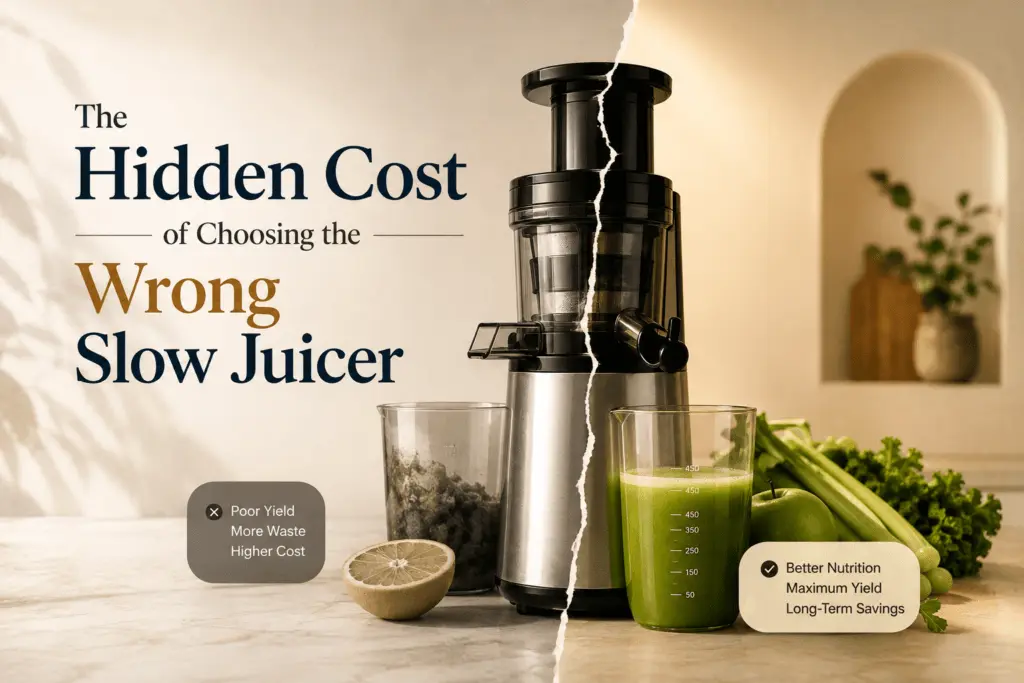
- Reduced juice yield over time: a worn or poorly designed strainer mesh lets more pulp through and extracts less juice per batch of produce, meaning you end up buying more fruits and vegetables to get the same amount of juice.
- Frequent clogging: an auger with poor tolerances jams easily on fibrous ingredients, forcing you to stop, disassemble and clear it mid-juicing, turning a quick morning routine into a frustrating chore.
- Shorter appliance lifespan: low-grade plastic gears and augers crack or strip under repeated pressure, often within a year or two of regular use, leading to an unplanned replacement purchase.
The real cost of a cheap slow juicer is not the purchase price. It is the wasted produce, the clogging, and the appliance that quietly stops getting used within a few months.
3. Slow Juicer Cleaning: An Overlooked Daily Cost
A poorly designed slow juicer with narrow feeding chutes, hard-to-reach strainer mesh, and non-dishwasher-safe parts adds significant daily time cost. If cleaning takes fifteen minutes instead of five, many people simply stop using the appliance altogether within a few months, turning the entire purchase into wasted money sitting unused on a counter.
4. What to Look for to Avoid These Hidden Costs
- Wide feeding chute: reduces prep time since you do not need to chop produce into tiny pieces before juicing.
- Reverse function: lets the auger rotate backward automatically to clear minor clogs without manual disassembly.
- Dishwasher-safe parts: significantly cuts down daily cleaning time and encourages consistent daily use.
- Metal or reinforced auger gears: last considerably longer under regular use than all-plastic components.

5. Frequently Asked Questions
Q: What is a slow juicer?
A juicer, or masticating juicer, uses a slow-rotating auger to crush and press produce against a fine strainer at low speeds, generating less heat and oxidation than a fast centrifugal juicer.
Q: Why do cheap slow juicers produce less juice over time?
Lower-grade strainer mesh and auger components wear down faster, letting more pulp through and reducing overall juice yield from the same amount of produce.
Q: Does a slow juicer preserve more nutrients than a regular juicer?
Many nutritionists believe so, since the slower process generates less heat and oxidation, which can help retain more vitamins, enzymes and antioxidants.
Q: What features prevent a slow juicer from clogging?
A reverse function that automatically rotates the auger backward, along with well-machined auger and strainer tolerances, significantly reduce clogging on fibrous produce.
Q: Why does cleaning difficulty matter when choosing a slow juicer?
If cleaning is tedious and time-consuming, people tend to stop using the appliance regularly, effectively wasting the money spent on it.
6. Conclusion
Choosing a slow juicer with a wide feeding chute, dishwasher-safe parts and durable auger components avoids the hidden costs of wasted produce, frequent clogging, and an appliance that ends up unused.
Before choosing a slow juicer, see what features actually matter in everyday use. Explore the Glen Hopper Slow Juicer with our product experts through a live video demo.