Food Processor vs Mixer Grinder: What Each One Does Better
 Blogs
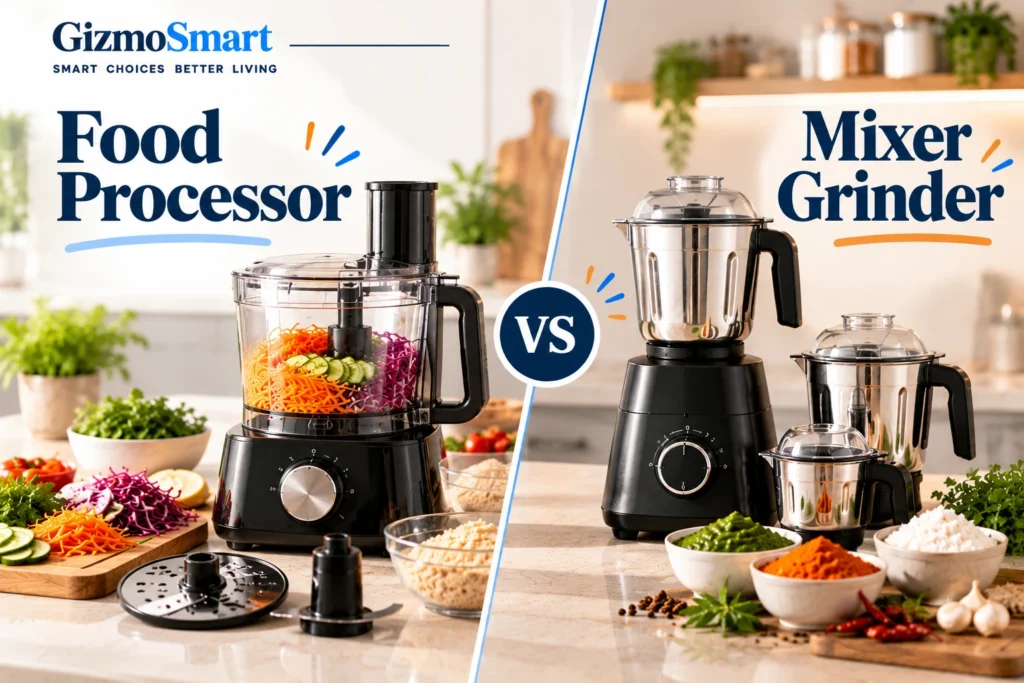
The food processor vs mixer grinder comparison comes up often when setting up a kitchen. Both appliances speed up food preparation, but they are designed for different tasks. A mixer grinder excels at grinding, blending, and making smooth pastes, while a food processor is built for chopping, slicing, shredding, and kneading, often in larger quantities.
Understanding this difference helps you choose the right appliance instead of picking one based only on motor power or the number of attachments. The best option depends on what you cook regularly, how much food you prepare, and how much kitchen space you have.
1. What Is a Mixer Grinder?
A mixer grinder is a kitchen staple in Indian households, built mainly for grinding and blending. It’s commonly used for smooth chutneys, spice powders, ginger-garlic paste, masala pastes, purees, smoothies, and batter in suitable quantities.
The sharp blades and high-speed motor make it especially useful whenever a fine or smooth consistency is needed. This is why it fits naturally into everyday Indian cooking that relies on ground spices, coconut, nuts, onions, and tomatoes.
Different jars serve different purposes. A smaller jar is useful for chutneys and small quantities of ingredients, while larger jars can handle wet grinding and blending. Motor power, blade design, jar capacity, and build quality all influence performance.
If you’re choosing a mixer grinder, understanding how many jars your mixer grinder actually needs can help you avoid paying for attachments you rarely use.

2. What Is a Food Processor?
A food processor handles a wider variety of food preparation tasks rather than focusing mainly on grinding and blending. Depending on the model and attachments, it can chop vegetables, slice and shred fruits or vegetables, knead dough, make dips and sauces, mince ingredients, and process larger quantities of food.
Its interchangeable blades and discs reduce manual chopping and preparation time. A wide processing bowl also makes it convenient when preparing ingredients for family meals or gatherings.
However, food processors vary considerably. Some models are designed primarily for chopping and slicing, while others include dough blades, shredding discs, and additional accessories. Check which attachments are included before buying because not every food processor supports every task.
3. Food Processor vs Mixer Grinder: Key Differences
The main difference comes down to the type of food preparation each appliance handles best. A mixer grinder is designed for grinding and blending, while a food processor specialises in cutting, slicing, shredding, and other preparation tasks.
| Feature | Mixer Grinder | Food Processor |
|---|---|---|
| Main purpose | Grinding and blending | Chopping, slicing, shredding, and processing |
| Grinding spices | Excellent for suitable quantities | Depends on the model and attachment |
| Making chutneys | Well suited to smooth chutneys | Can handle some dips and sauces, depending on design |
| Preparing smooth pastes | Generally the better choice | Performance varies by model |
| Chopping vegetables | Limited without a suitable attachment | One of its main strengths |
| Slicing and shredding | Not a standard function on most models | Usually supported through dedicated discs |
| Kneading dough | Not designed for conventional dough kneading | Supported by some models with dough blades |
| Large-batch preparation | Depends on jar capacity | Often convenient due to a larger bowl |
| Attachments | Usually includes different jars and blades | May include interchangeable blades, discs, and dough tools |
| Best suited for | Everyday grinding, chutneys, and blending | Vegetable preparation and multiple processing tasks |
A mixer grinder excels at grinding spices, making chutneys, and preparing smooth pastes. A food processor is more convenient for chopping, slicing, shredding, and handling a variety of preparation tasks.
Neither appliance is automatically better overall. Your cooking habits should determine which one makes more sense.
4. What Does a Mixer Grinder Do Better?
A mixer grinder is particularly useful for recipes that require grinding ingredients into a fine powder, smooth paste, or blended mixture.
- Grinding spices: Its high-speed blades make it convenient to grind dry spices into powders for everyday masala preparation. The results depend on the jar design, blade condition, and quantity being processed.
- Making chutneys: Coconut, coriander, tomato, and similar chutneys come together quickly in a mixer grinder. A suitable jar helps achieve the desired consistency without processing an unnecessarily large quantity.
- Preparing smooth pastes: Ginger-garlic paste and onion-tomato mixtures get the smooth consistency many Indian recipes call for. This makes the appliance useful for preparing ingredients before cooking curries and gravies.
- Blending drinks: Milkshakes, smoothies, and fruit-based drinks are another area where a mixer grinder is practical, provided the jar is suitable for liquids.
Motor power also matters when choosing a model for regular grinding. Our guide to choosing the right mixer grinder wattage explains what wattage means and which factors to consider beyond the number printed on the appliance.
5. What Does a Food Processor Do Better?
A food processor is designed to reduce the time spent on repetitive preparation tasks. Its interchangeable blades and discs make it useful for jobs that would otherwise require considerable manual effort.
- Chopping vegetables: The appropriate blade can process larger quantities of vegetables more quickly than manual chopping. The final texture depends on the blade and how long the ingredients are processed.
- Slicing and shredding: Interchangeable discs speed up slicing cucumbers, carrots, or potatoes and shredding vegetables for salads, fillings, and other recipes. These attachments can also help produce more consistent pieces.
- Kneading dough: Many food processors include dough blades for bread, pizza, or similar recipes. However, capacity and recommended quantities should always be checked because not every model is designed for heavy dough preparation.
- Preparing dips and sauces: Depending on the design, a food processor can combine ingredients for dips, spreads, and sauces. Its wider bowl can be convenient when preparing larger batches.
- Handling larger quantities: Larger bowls make food processors useful when preparing meals for a family or gathering. You can process more ingredients in one batch, although the usable capacity varies between models.
A food processor is particularly worthwhile for people who regularly prepare salads, chop vegetables in bulk, or use multiple processing attachments. If your cooking mainly involves grinding spices and making chutneys, a separate food processor may be less essential.
6. Which One Should You Buy?
Your daily cooking routine is the simplest way to decide between these appliances.
Choose a mixer grinder if your priority is:
- Grinding spices and preparing masalas
- Making chutneys and ginger-garlic paste
- Blending smoothies, drinks, and purees
- Preparing ingredients for everyday Indian cooking
- Grinding small or medium quantities using suitable jars
Choose a food processor if your priority is:
- Chopping vegetables frequently
- Slicing and shredding ingredients
- Preparing ingredients in larger quantities
- Kneading dough with a compatible attachment
- Using different blades and discs for food preparation
If you regularly need both types of tasks, having both appliances can be worthwhile. However, kitchen space, budget, and how frequently you use each function should guide the decision.
Some mixer grinders are sold with food processor attachments. These can offer additional functionality without requiring two separate appliances, but their performance and included attachments vary by model. Read our guide to whether one mixer grinder can handle every kitchen task before deciding whether a combination appliance suits your needs.
There’s no universal winner here. A mixer grinder is the better specialist for grinding and masala preparation, while a food processor is more versatile for chopping, slicing, shredding, and bulk preparation.

7. Frequently Asked Questions
Can a food processor replace a mixer grinder?
Not entirely. A food processor can process ingredients and handle some grinding tasks, depending on the model, but a mixer grinder is generally better suited to fine grinding, traditional chutneys, and smooth pastes.
Can a mixer grinder chop vegetables like a food processor?
Not as effectively as a dedicated food processor for most slicing and shredding tasks. Some mixer grinders include chopper attachments, but their capabilities depend on the attachment and model.
Is a mixer grinder enough for Indian cooking?
For most everyday Indian cooking involving ground spices, chutneys, masala pastes, and blending, a mixer grinder covers many essential tasks. A food processor becomes more useful if you frequently chop, slice, shred, or process larger quantities.
Do I need both a food processor and a mixer grinder?
If you regularly prepare vegetables in bulk and also grind spices or make chutneys, having both appliances can be useful. If you have limited kitchen space or a tight budget, start with the appliance that covers your most frequent tasks.
Which is better for making dough, a food processor or a mixer grinder?
A food processor is generally the more suitable option when it includes a dedicated dough blade and supports the required quantity. A conventional mixer grinder is not designed for regular dough kneading.
8. Conclusion
The food processor vs mixer grinder decision comes down to your cooking habits rather than which appliance has more features. A mixer grinder is the better specialist for grinding, blending, chutneys, and Indian masala preparation, while a food processor is more versatile for chopping, slicing, shredding, and bulk preparation.
If you cook Indian meals regularly and mainly need to grind ingredients, a mixer grinder may be sufficient. If you spend more time chopping vegetables, preparing salads, or working with different ingredients in larger quantities, a food processor may be the more useful addition to your kitchen.